Are you tired of sending out generic marketing campaigns that fail to engage your target audience? Well, it’s time to say goodbye to mediocre results and hello to an exciting new way of enhancing your inbound marketing strategy – audience segmentation!

In this blog post, we’ll be exploring the power of audience segmentation in enhancing your inbound marketing efforts. So, grab a coffee, get comfortable, and let’s dive into the world of audience segmentation together!

Definition of Audience Segmentation

Audience segmentation is the process of dividing your target audience into smaller, more defined groups based on common characteristics such as age, gender, behavior, and interests. By doing so, you can tailor your marketing messages to each segment, making them more relevant and effective.

Importance of Audience Segmentation in Inbound Marketing

Audience segmentation is a crucial component of inbound marketing, and here’s why:

  1. Improves Relevance and Effectiveness of Marketing Messages: By dividing your audience into smaller, more defined groups, you can tailor your marketing messages to the specific needs and preferences of each segment. This leads to higher engagement and conversions as the messages are more relevant to the audience.
  2. Increases Personalization: Personalization is a key aspect of inbound marketing, and audience segmentation helps you achieve it. By understanding the unique characteristics of each segment, you can craft personalized messages that resonate with each group.
  3. Increases Efficiency: Audience segmentation enables you to focus your marketing efforts on the segments that are most likely to convert. This saves time and resources and helps you get the most out of your inbound marketing campaigns.
  4. Enhances Customer Experience: By providing relevant and targeted content to each segment, you improve the overall customer experience. This leads to increased brand loyalty and advocacy, which can help you attract new customers and drive growth.

Improves Data Insights: By analyzing the performance of each segment, you can gain valuable insights into the behavior and preferences of your target audience. This information can help you make data-driven decisions about your marketing strategy and refine your audience segments over time.

Understanding Your Target Audience

Collecting and Analyzing Data on Your Target Audience

To effectively segment your audience, you need to understand your target audience. The first step in this process is collecting and analyzing data on your audience. There are a variety of methods you can use to gather this information, including:

  • Surveys: You can use surveys to gather data on the demographics, interests, and behaviors of your target audience. You can use this information to create segments based on common characteristics.
  • Analytics: Analyzing website and social media analytics can give you a wealth of information about your target audience. For example, you can see which pages and content are most popular among your audience, which can help you determine their interests and preferences.
  • Customer Feedback: Asking for customer feedback can provide valuable insights into the needs and preferences of your target audience. This information can help you create segments and tailor your marketing messages accordingly.

Determining Common Characteristics Among Audience Segments

Once you have collected data on your target audience, the next step is to determine common characteristics among your audience segments. You might want to think about the following characteristics:

  • Demographics: Age, gender, location, and income are all demographic characteristics that can be used to create audience segments.
  • Interests and Behaviors: Understanding the interests and behaviors of your target audience can help you create segments based on common activities, hobbies, and habits.
  • Pain Points: Identifying the pain points and challenges that your target audience faces can help you create segments based on the solutions they are seeking.
  • Customer Journey: Understanding the customer journey can help you create segments based on the stage of the journey that each customer is in. For example, you might have a segment for customers who are just starting to consider your product, and another segment for customers who are ready to make a purchase.

How to Use Data to Create Audience Personas

Once you have identified the common characteristics among your audience segments, the next step is to use the data to create audience personas. An audience persona is a fictional representation of a specific segment of your target audience. It includes demographic information, interests, behaviors, pain points, and goals.

Creating audience personas allows you to understand your target audience on a deeper level and helps you create marketing messages that resonate with each segment. By using data to create audience personas, you can ensure that your marketing messages are relevant, targeted, and effective.

Creating Segments

Types of Audience Segments

There are many different types of audience segments, but here are a few of the most common:

  • Demographic Segments: Demographic segments are based on demographic data such as age, gender, location, and income.
  • Behavioral Segments: Behavioral segments are based on behaviors and actions, such as the pages a customer visits on your website or the products they have purchased in the past.
  • Psychographic Segments: Psychographic segments are based on personality, values, and lifestyle.
  • Firmographic Segments: Firmographic segments are based on firmographic data such as size of the company, industry, and location.

How to Create Meaningful and Relevant Segments

Once you have considered the key factors and determined the types of segments you want to create, the next step is to create meaningful and relevant segments. Here are some suggestions to get you started:

  1. Start Small: It can be tempting to create many different segments, but it’s better to start small and focus on a few well-defined segments.
  2. Focus on Relevance: Make sure your segments are relevant to your target audience and their needs. This will ensure that your marketing messages resonate with each segment.
  3. Refine Your Segments Over Time: Your target audience and their needs may change over time, so it’s important to regularly review your segments and refine them as needed.

Tailoring Your Marketing Messages

Crafting Targeted Messages for Each Segment

Once you have a good understanding of the needs and preferences of each segment, the next step is to craft targeted messages for each segment. Here are a few tips to help you create effective targeted messages:

  • Personalize Your Messages: Personalizing your messages can help you create messages that resonate with each segment. This can be as simple as addressing each segment by name, or as complex as creating custom messages for each segment.
  • Focus on Benefits: When creating your messages, focus on the benefits that your product or service provides to each segment. This will help you create messages that resonate with each segment and motivate them to take action.
  • Use Data: Use data to support your messaging decisions. This will help you ensure that your messages are relevant and effective.

How to Measure the Success of Targeted Messages

Once you have created your targeted messages, the next step is to measure the success of your messages. Here are a few metrics that you can use to measure the success of your messages:

  • Conversion Rates: Conversion rates are a good way to measure the success of your targeted messages. You can track conversion rates for each segment and compare them to see which messages are most effective.
  • Engagement Rates: Engagement rates are another way to measure the success of your targeted messages. You can track engagement rates for each segment and compare them to see which messages are resonating with your target audience.
  • Customer Feedback: Customer feedback can be a valuable tool for measuring the success of your targeted messages. You can ask customers for feedback on your messages, and use this information to refine your messages and make them more effective.

Best Practices for Audience Segmentation

Importance of Regular Analysis and Adjustment

Audience segmentation is not a one-time effort, but rather a continuous process. Regular analysis and adjustment of your segments is important to ensure that your inbound marketing efforts remain effective over time. Here are a few reasons why regular analysis and adjustment is important:

  • Changing Needs and Preferences: The needs and preferences of your target audience can change over time. Regular analysis and adjustment of your segments can help you stay up-to-date with the changing needs and preferences of your target audience.
  • Improved Segmentation: Regular analysis and adjustment can help you refine your segments, making them more meaningful and relevant. This will help you create targeted messages that resonate better with your target audience.

How to Test and Refine Your Segments

Testing and refining your segments is an important part of the audience segmentation process. Here are 2 ways to test and refine your segments:

  • A/B Testing: A/B testing is a powerful tool for testing and refining your segments. You can use A/B testing to compare the performance of different segments and make informed decisions about which segments to keep and which to eliminate.
  • Analytics: Analytics can help you test and refine your segments by providing data on the performance of each segment. You can use this information to make informed decisions about which segments to keep and which to eliminate.

Conclusion

Audience segmentation is a powerful tool that can significantly enhance your inbound marketing efforts. By providing relevant and targeted content to each segment, you can improve the customer experience, increase conversions, and drive growth for your business.

Take your business to the next level with elfo’s Email Marketing Management Services and Social Media Management Services. Our team of experts will help you connect with your audience and achieve your marketing goals through customized strategies and advanced technology.

Contact us today to schedule a free consultation and find out how we can help you succeed online!

By the end of 2022, most countries have already opened their borders and stopped enforcing major quarantine measures, so everybody is travelling more frequently and returning back to office. For email marketers, what this means is that more people are likely to open and read their emails, especially during morning and evening commutes.

To know for sure, email marketing makes measuring easy by providing valuable data that includes:

  • How many emails were sent to your customers
  • Emails opened by browsers or devices
  • Delivery rate
  • Click rates
  • Unsubscribe rate

Let’s check out how well your email marketing efforts have performed in 2022.

Email rates climb to a higher peak

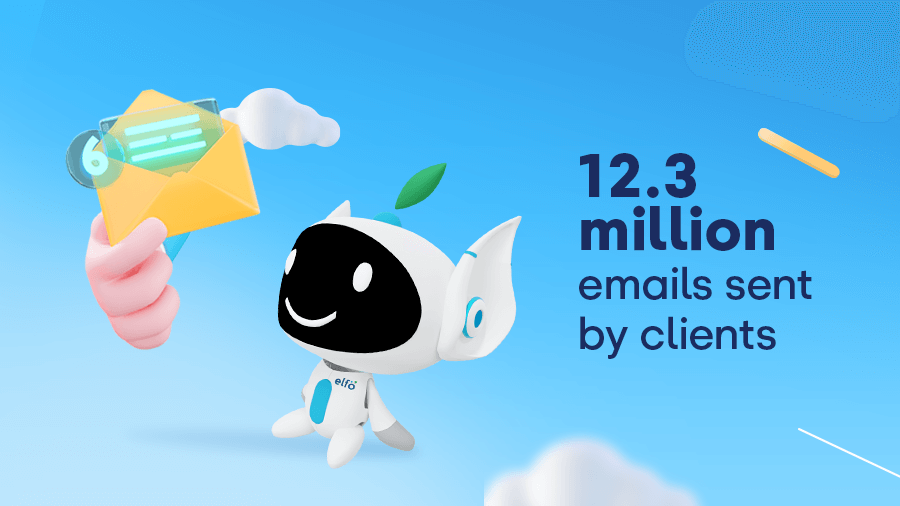
Email marketing still remains one of the most affordable marketing channels that has a better chance of guaranteeing long-term gains. This year, we helped our clients deliver over 12.3 million emails!

Your emails are best read on…

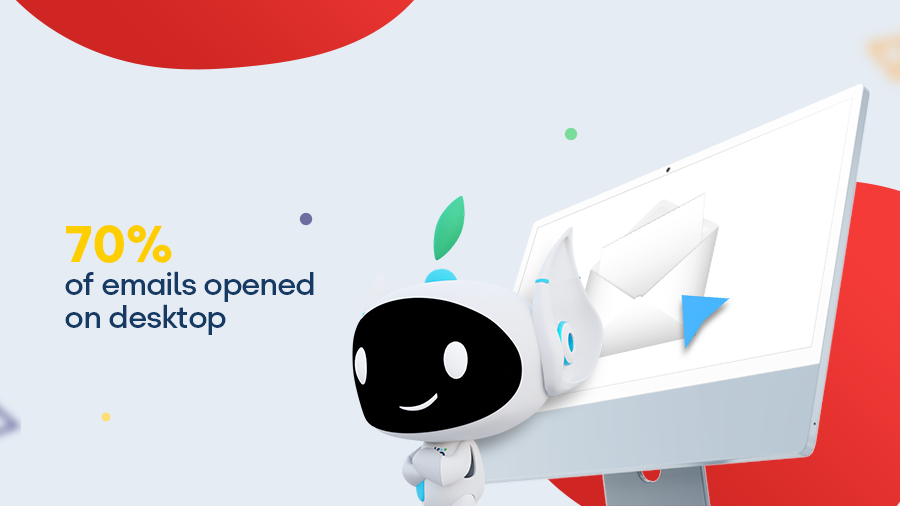
Despite the growing popularity of social media, email marketing is still very much in use today, especially on bigger screens. 93% of your emails were opened on desktop.

A good chunk of people still uses email

Email is still a way of communication that everyone uses – whether you’re from a younger or older generation. Emailing someone seems more professional, so people generally still take it more seriously.

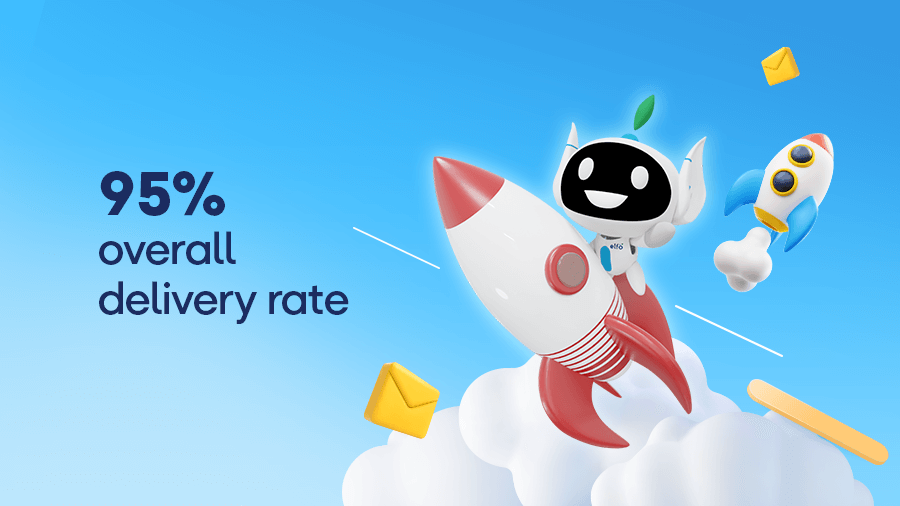
You achieved a fantastic 95% delivery rate, which means that nearly all of your emails arrived in the right inboxes and didn’t bounce.

Your messages connected with more people

Email lets you personalize your message in ways that social media can’t match, so email marketing is still an excellent platform to market your products and services.

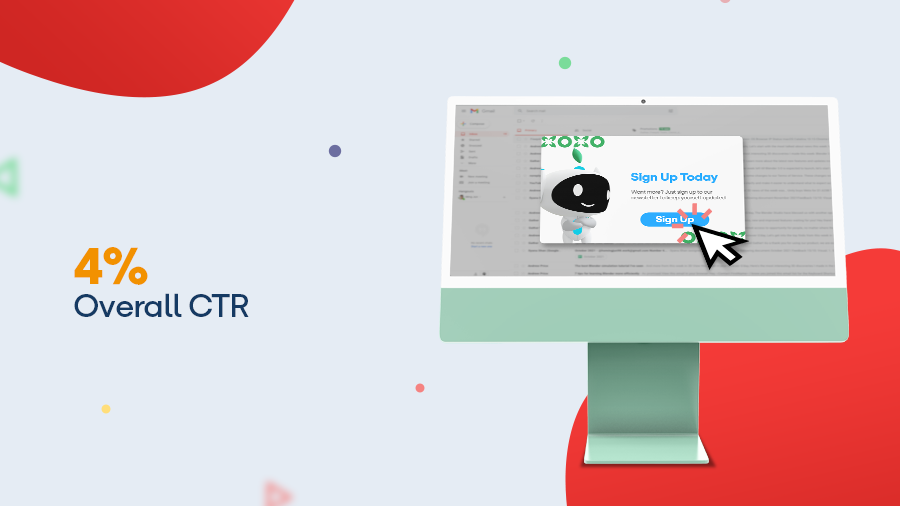
Customizing emails allows you to incorporate several elements to entice people to visit your website. Your efforts seem to have worked, because you achieved 6% CTOR!

Your subscribers want to know what you’re offering

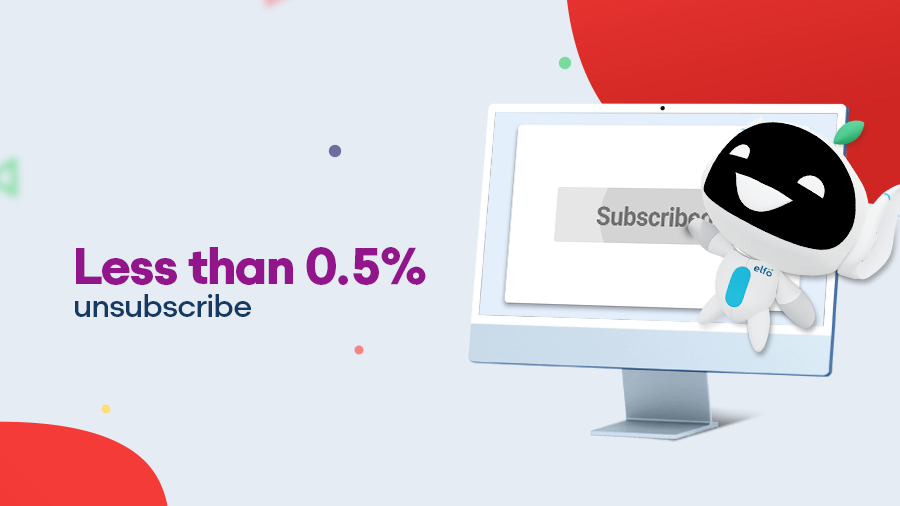
To do email marketing right, you need to send your subscribers valuable content that will keep them interested in your brand. Congratulations! Less than 0.2% unsubscribed from your newsletter this year.

Email marketing is worth investing in for business growth

Email marketing is still relevant and has a long future ahead because it’s so easy to use and cost-effective to scale. As the upward trend of email marketing continues, you’ll want to make sure that your brand is ahead of the marketing game.

To all our existing clients that use our Email Marketing Management Services, thank you for entrusting us with creating your messages and campaigns. We hope to continue working with you to grow your audience in 2023!


Email marketing may not be the trendiest or newest marketing channel, but it’s still a vital way to generate leads and convert more prospects for your business.

elfo wants to share a number of email marketing best practices your business can use to meet the expectations of your target audience and grab their attention.

elfo’s Email Marketing Best Practices

  1. Use a personalised sender name.
  2. Have a real reply-to address.
  3. Do not buy email lists.
  4. Get recorded permission before sending emails.
  5. Ask for subscription twice.
  6. Segment groups in your email list.
  7. Clearly inform people who join your list what to expect from you.
  8. Reduce dormant subscribers to reduce bounce rate.
  9. Make sure to insert an unsubscribe link in every email.
  10. Avoid spam trigger words in your subject lines.
  11. Avoid including playable media content.
  12. Avoid embedding forms.
  13. Avoid including attachments.
  14. Reduce the number of images for quick load times
  15. Double-check spelling and grammar.

elfo, digital marketing

For email marketing, remember that your primary goal is to build a solid relationship with your customers. It’s not enough to just grab their attention; you need to do more to secure their trust.

1. Use a personalised sender name.

When sending your emails, use a sender name that preferably contains your personal name so that recipients quickly recognize you. An email address like firstnamelastname@domain is appropriate, NOT an obscure one like 1234vds@domain. What’s the reason for this?

People are bombarded with emails every day so they usually comb through their inbox and open the interesting ones. In most cases, people tend to open those which include a personal name in the ‘from’ box because these are easier to identify immediately amongst the sea of impersonal, generic ones.

Another good reason to stick to only using a personalised sender name is that leading email service providers actually pay close attention to the ‘from’ field. Today’s spam filters have reputation-based filtering that gathers information about the source of the email (IP address and domain).

2. Use a real reply-to address.

When creating your next email campaigns, try to avoid using emails like [email protected] as the reply-to address. While you may not require recipients to respond to certain emails you send them, email addresses like this imply to people you are not interested in hearing from them.

If you use this kind of address too often, it will prevent your company from receiving the engagement you want from email marketing by reducing the number of valid responses you get. Using friendlier-sounding email addresses encourage people to respond. Here are ones that a lot of companies typically use:

Read more: How to Onboard New Customers with Welcome Emails

3. Do not buy email lists.

It’s always safer, smarter, and healthier for your business’ reputation to build an email list from scratch.

Arguably, the biggest offense you can commit is buying email lists because sending your emails to addresses you didn’t obtain legitimately is wrong – plain and simple. Legally, it represents a violation of your Internet Service Provider’s Terms of Service.

Inversely, this means that selling or transferring email addresses (without permission) to other lists is also illegal. Don’t commit a violation of people’s privacy by buying lists as they never accepted to be contacted by you and this is a one-way ticket to be blacklisted.

Read more: How to Easily Collect Email Addresses for Free

4. Get recorded permission before sending emails.

No matter whether customers buy a product from your website for the first time or the tenth time, do not send promotional emails without getting their permission first. Have customers agree through a clear sign-up form on your website or give them the option to sign up for your newsletter after they make a purchase from your store.

5. Ask for subscription twice.

Even after their subscription, send your new subscribers a follow-up email asking them to confirm whether they do want to receive emails from you. If they really want to receive your content or offers, they won’t mind. This practice of double opt-in helps you to keep your list nice and clean.

6. Segment groups in your email list.

If you want to see better results from your email marketing efforts, don’t simply send the same email to every address in your list. Segment groups based on what they’re interested in so that you’re only sending relevant offers to the right people.

7. Clearly inform people who join your list what to expect from you.

Telling people what you’ll be sending and how often you’ll be sending emails establishes transparency and earns the trust of your subscribers early on. If you intend to send out various content (monthly newsletters, weekly special offers, etc.), create some options for people to choose what content they want to receive from you.

8. Remove dormant subscribers to reduce bounce rate.

During every reporting cycle, pay attention to subscribers who aren’t opening your emails. If it’s reoccurring inactivity, you should consider either launching a re-engagement campaign or remove these addresses from your lists. Why?

Because bounce rates are one of the important factors ISPs keep track of to determine your sender reputation. Inactive subscribers contribute to this statistic and it might damage the reputation of your company’s domain which directly influences deliverability rates.

9. Make sure to insert an unsubscribe link in every email.

Sometimes people lose interest in your content or offers; it happens. If they want to unsubscribe from your mailing list to stop receiving your emails, you must let them go.

Simplify the journey by putting an unsubscribe button at the bottom of your emails. Never try to email the same addresses again unless they sign up for a new subscription. If you continue to send them emails, you will most likely be marked as spam, bringing down your sender reputation.

10. Avoid spam trigger words in your subject lines.

Pay attention when crafting the wording of your email subject lines. There are certain words and phrases that set off spam filters and if you use them often enough for your emailing campaigns, it may get you blacklisted, owing to their association with real spam mail.

Remember all those emails you received before that offered ‘something’ in the subject line in return for following a couple of ‘simple’ steps? Well, due to their sheer frequency, spam trigger words were usually collected from many emails like these.

Here are some examples you should try to avoid if you don’t want spam filters to catch you:

  • Exclusive deal
  • Limited time
  • Offer expires
  • While stocks last
  • No questions asked

“Win” is considered one of the spammiest words. Avoid them using them at all costs. Also, exclamation marks tend to hurt open rates and Gmail tab placement so avoid them. Never use all-caps words in email subject lines because it makes you look suspiciously like a spammer and you’re shouting.

11. Avoid including playable media content.

Nowadays, a majority of ESPs don’t allow people to view rich media content on their emails, so avoid putting videos in your emails. If you do, and they don’t show or work properly, the email will look like spam to your clients. We recommend not to use image file size more than 100KB.

If part of your marketing campaign requires media content, why not put it on your website and insert a link to it in your email copy instead? You can include an image with a play button that, once clicked, will lead your clients to the particular video on your website.

12. Avoid embedding forms.

Spam filters are pretty comprehensive and embedding forms in your email copy represents another red flag. While these forms are needed to collect details from your clients, they are a security risk and ESPs don’t usually support them. Use the same alternative for media content: either link to the form you wish them to fill in or insert a call-to-action button.

13. Avoid including attachments.

For some targeted campaigns, you might want to attach a file, like Word documents or PDFs, to your emails. Unfortunately, thanks to spam emails in the past hiding viruses, attaching files to your emails alert spam filters immediately. Avoid doing this if you can.

Another good reason why attachments should be left out is that attached files also increase the size of your email, so consequentially, it takes them longer to load. Instead, place the file on your website and provide a link or a CTA that allows the file to be viewed and downloaded.

14. Reduce the number of images for quick load times.

Understandably you’d like to catch your reader’s attention with attractive images and unique designs, but for email marketing you need to be smart with this. Including a lot of images will increase the load time of your email, which can affect deliverability rates.

Making your email copy in the form of one big image is also not recommended because you can run the risk of it not even loading. For example, Microsoft Outlook doesn’t recognize background images so an email that has this will most likely not be displayed correctly.

To avoid any of these issues, only include images that are relevant to the content. Resize the images if necessary, but be careful their visual integrity does not fall. Don’t forget to also host your images only at credible services.

15. Double-check spelling and grammar.

Getting acknowledged digitally means being credible to your clients, customers and audience. Make sure that you proofread every single one of your email marketing campaigns. If you want to be seen as reliable and trustworthy, avoid spelling and grammar mistakes at all costs. Take the time and extra care to edit and proofread.

What Are Spam Filters?

Email Marketing Tools

While your business may be sending legitimate emails with the best of intentions, there are several reasons that stop many emails from being seen.

The most prominent one is spam filters that are taking down scores of emails of questionable reputation before they reach inboxes.

Spam filters are essentially a kind of safeguard technology that scans over and interprets the “spamminess” of an email. They count each factor of the spam you send and add them up to assign a spam score, which helps determine whether campaign passes through the filter.

If the score goes over a certain limit, your email will get flagged as spam and go straight to the junk folder, no matter what the content is. The list of criteria for what constitutes spam is constantly growing and adapting, based on—at least in part—what people identify as spam with the ‘Mark as Spam’ or ‘This is junk’ button in their inbox.

Another issue is that each spam filter functions a bit differently so not only can “passing” scores differ, but their criteria are determined by individual server administrators. This means that even if an email passes through Spam Filter A without incident, Spam Filter B may be alerted by something in the email and flag it.

What Common Criteria Count Towards Spam?

  • Campaign metadata

Stranger danger! Spam filters don’t like it if you’re not acquainted with the person receiving the email. We recommend using merge tags to personalize the To: field of your campaign and only send through verified domains.

  • Your IP address

If anyone with the same IP has sent spam in the past, some spam filters are more likely to flag an outgoing campaign

  • Coding in your campaign

Be careful of sloppy coding, extra tags, or code pulled in from Microsoft Word when designing your email layout.

  • Content and formatting

Sometimes spam filters will flag emails based on specific content or images they contain.

Email Marketing Solutions

That’s it! With the email marketing best practices above, you can eliminate most of the mistakes affecting your email deliverability rates.

Today, most consumers don’t buy a product or service at first glance. They take time to consider the product features and even make cross-comparisons with other brands.

However, each day, consumers are bombarded with promotional emails, ads, and sales calls from companies that all promise to fix their problems. Your customers’ consideration stage gets disrupted by all this noise, affecting your genuine communication efforts.

Building an effective customer engagement strategy is what you need to cut through all the noise and close that sale. This article will explain why is customer engagement important and how to harness its benefits for your company.

What is Customer Engagement?

Customer engagement is the process of interacting with customers and building a relationship with them. This can be accomplished through multiple platforms via marketing campaigns, new content posted on websites, and social media outreach, among other methods.

Why is Customer Engagement Important?

positive customer experience

Fostering a positive relationship with your customers helps promote your brand, generate more sales, and provide a memorable experience for your customer on a more personal level.

While the primary incentive of building a relationship with your customers will be to make money initially, having customers who trust your business will keep them around for the long term, making them repeat customers.

Another great outcome is that loyal customers spread the word to other people. When customers feel that they are treated positively, it makes it much more likely they will go out of their way to help promote your business socially through word-of-mouth or on third-party websites and forums.

Your sales team can also reap benefits from proactive customer engagement because more customer interactions mean more opportunities to develop and refine customer insights. Those customer insights can inform marketing decisions and sales processes.

How to Improve Customer Engagement

engaging customers

There are several different ways to create customer engagement. These are some of the common areas that companies invest their efforts into:

  • Customer services
  • Buying experience (online and offline)
  • Website navigation
  • Social media outreach

Nurture Your Customers At Every Step

When it comes to improving your communications with your customers, your customer engagement strategy should heavily consider what existing and potential customers need throughout their purchase journey.

Clearly define your target audience’s purchase journey and add relevant touchpoints for customer engagement. Each touchpoint should provide helpful, personalized information that supports customers’ evolving needs throughout the funnel.

Maintain Customer Interest

While you should know your own company’s brand, mission, and values, you must also be aware of the overall goals and motivating factors of your customer base. By always keeping your customer’s needs and priorities in mind, you can ensure that your engagement strategy does not go astray.

Create content that is relevant, as well as resourceful, by gathering data and qualitative customer feedback. You’ll be able to more accurately understand the customer’s perspective and curate personalized customer experiences that keep them coming back for more.

Get Creative with Customer Engagement

Think carefully and strategically about the marketing content and the outreach channels you’ll use because it may affect how your customer interactions are perceived. You need to create a positive brand perception and boost engagement across all channels.

Nowadays, almost everybody has access to some kind of social media platform to interact with the world. Consider expanding your outreach and marketing campaigns to newer platforms, especially if you’re trying to appeal to a younger demographic.

However, be mindful of the type of messages you write on platforms such as Twitter and Facebook because this can make or break customer loyalty and trust fast.

Build Customer Trust

Arguably, the greatest challenge of customer engagement is continuously providing and maintaining a high level of expertise, transparency, quality, and customer satisfaction. Customers who connect with your brand will treat each product or service advertisement as a promise.

Your customer’s trust must be earned, so helping to solve their complaints and issues is the fastest way to instill confidence that your company has their best interests in mind. This makes it much easier to sell to them in the future.

Your engagement strategy may include collecting regular feedback from customers on their experience with your products and services. When receiving such feedback, respond thoughtfully, publicly post that feedback, and offer resources for support.

Boost Sales Success with Customer Engagement

Building trust between your sales team and customers is also important. As you strive to improve connections, customer engagement must always remain an essential component when moving through the sales funnel.

Remember that sales interactions shouldn’t feel forced. No matter which outreach channel your team chooses, you should maintain a friendly and helpful persona when interacting with customers.

More and more marketers are seeing better results from delivering timely, personalized content that creates qualified leads. The sales team should also aim to continue to nurture and engage buyers to establish long-term business relationships and increase close rates.

With insights gathered from customer interactions, your sales teams should develop thoughtful messaging and choose content that supports customers in narrowing down their options.

Conclusion

Don’t underestimate the power of good customer engagement! By regularly engaging with and nurturing your customers, your brand will remain top-of-mind and further strengthen the customers’ connection to your company.

Benefits of creating and improving customer engagement:

  • Boosts brand experience
  • Increases customer loyalty and trust
  • Provides valuable customer feedback and insight
  • Improves customer experience
  • Increases sales funnel velocity

Get in touch with our experts at elfo. Offering versatile tools like elfoMAP, we aim to simplify marketing challenges and improve the overall customer experience for our clients.

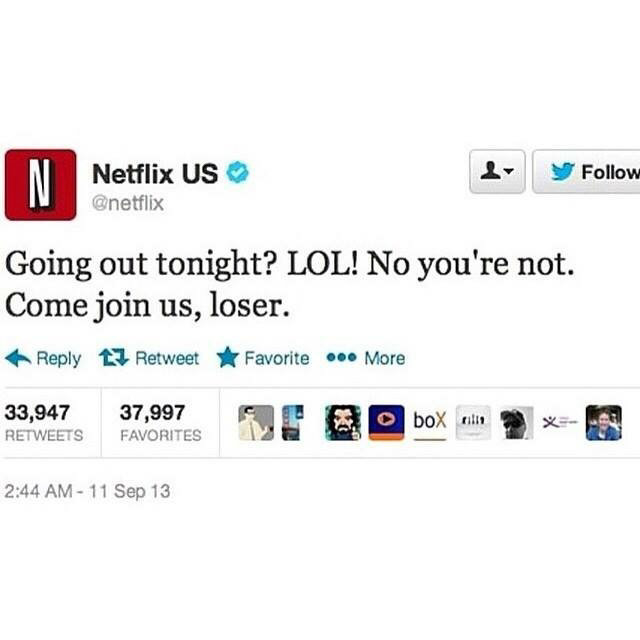
Let’s Netflix and Chill. 

This phrase appeared back in 2009 when Netflix was growing out to become more popular among home movie-streamers. Initially tweeted out by the brand, the phrase (regardless of the connotations, we don’t judge here) points out a marketing phenomenon that’s not just brilliant at subtlety but even better at conversions and growing fanbases.  

In walks, drip marketing – is a marketing tactic that revolves around nurturing customers with various marketing tools and materials by ensuring those materials or messages are consistent over a period of time. Consistency doesn’t just matter when it comes to drip marketing – to pull off a drip campaign successfully, a brand has to engage with its consumers through a cohesive story.  

That one phrase made Netflix the talk of all movie-lovers, creeping in subtly into people’s everyday conversations. For most people, Netflix and Chill define how one should spend one’s evenings after work.  

That punchy catchphrase brought fame to Netflix and here’s how drip marketing can do the same for your business too.  

What is drip marketing? 

Originally coined from the agriculture concept of drip irrigation – where crops are watered in sustained, steady, and balanced amounts of water to promote growth, drip marketing has many names – automation campaigns, marketing automation, automated life cycles, autoresponders, and many more.   

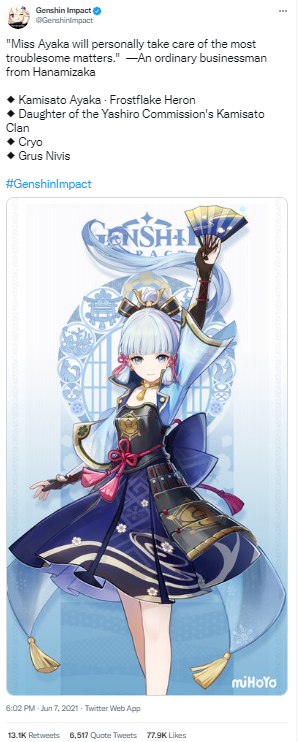
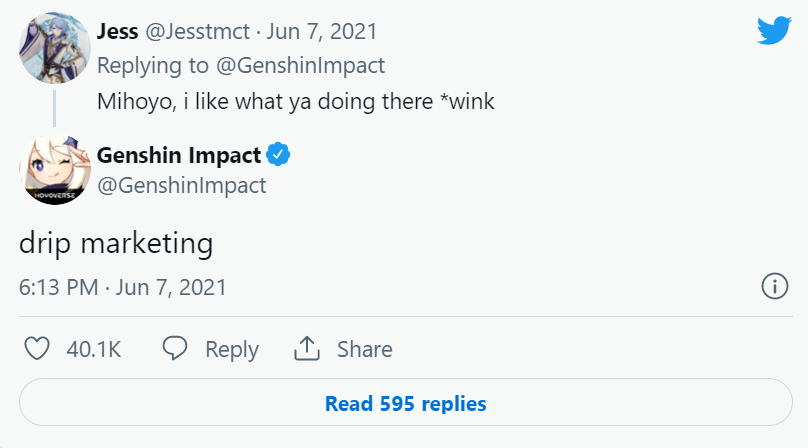
Although drip marketing can involve various marketing tools just like how miHoYo, the brand behind its popular video-game brainchild, Genshin Impact, utilizes its own social media accounts for drip marketing through new character drops, drip marketing is most oftentimes seen in emails as it is efficient and cost-effective.

Here’s a fun fact for you 

Did you know that Netflix sends out 1.76 emails/week and somehow… it works to their advantage?  

More emails don’t necessarily mean you might scare off your customers, it all boils down to how you utilize that form of the communication channel to foster the shared story of your products/services in exchange for their loyalty and purchase.  

So, what’s a drip campaign?  

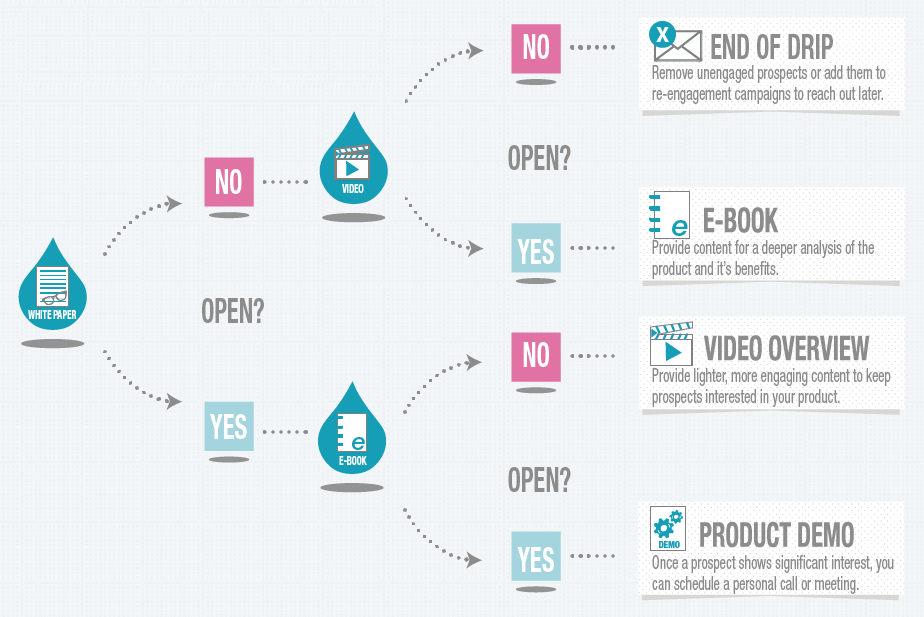
As portrayed in the figure above (Marketing automation company, Pardot’s drip campaigns), drip campaigns represent automated emails that are triggered by a customer’s reaction and are sent directly to the customer at specific times.  

This marketing technique enables a brand to foster consistent communication that coaxes a customer from one part of the customer journey to where you’d like them to be (oftentimes, lead generation).  

These automated emails take it one step further – each automated email is customized to the customer’s name, details, and even what they’re looking for – whether it’s a specific product or service.  

Do drip emails really work? 

Yup. Drip campaigns have an open rate of 80% higher than those of single-send emails, plus an inclination to generate 50% more sales-ready leads than mass email blasts.  

If that’s not enough to blow your mind, companies that excel in drip marketing are able to generate at least 80% more sales at 33% lower costs!  

Simply put, the benefits of drip marketing are just too great to ignore.  

When to drip market? 

Although drip marketing is a blanket term that can feature a variety of marketing tools (including emails!), the goal remains the same – keep consumers engaged with your brand and offerings at any stage of their customer journey. 

Nurturing leads 

It’s no surprise that leads generation is the main focus for most companies – which is why drip marketing can become an asset to promote lead generation for leads at any stage of the customer journey.  

Research shows that each customer needs at least 7-13 “touches” or interactions to close each sale. With each “touch” of the emails automated to your customer’s inboxes, you’re closer to making the sale! 

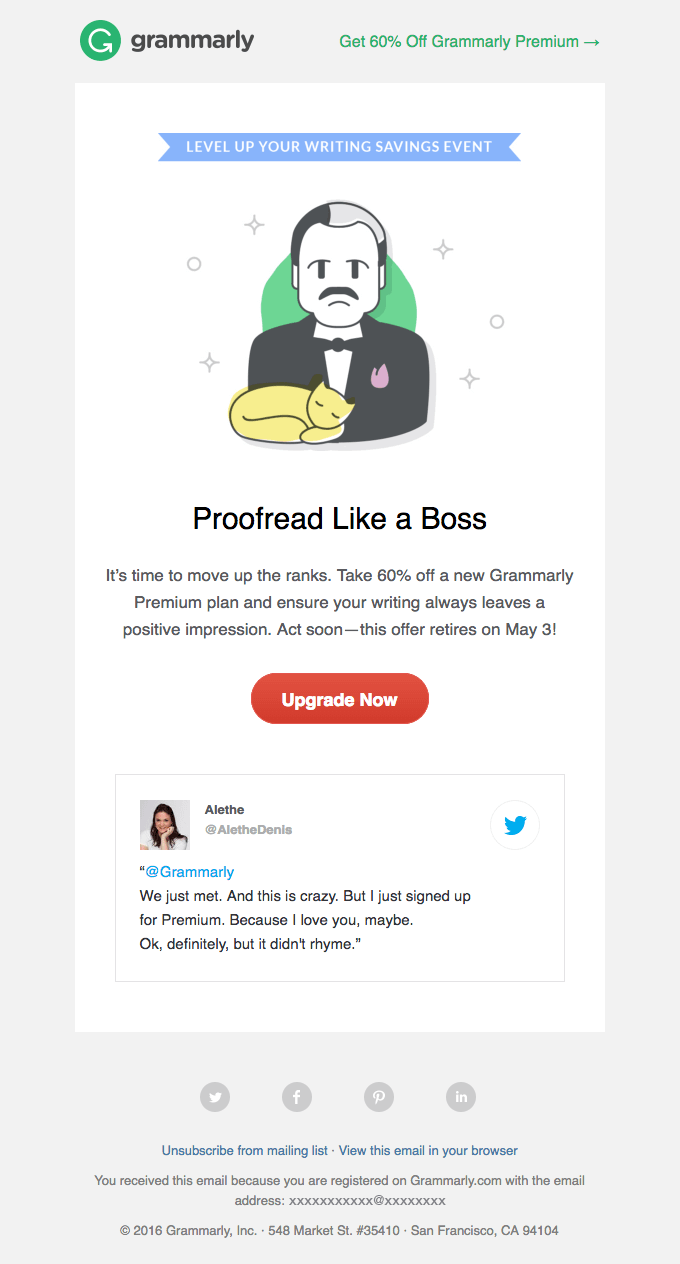
Here’s an example of how Grammarly automates its lead-generation emails.

What works here:

  • Personalize each email, especially at this stage – to show how your brand is dedicated to providing a newer upgrade/solution to each customer’s needs. Notice how the brand mentioned, “moving up the ranks”? That shows that the customer has been engaged with the brand at a lower level of commitment prior to this. 
  • Dangle that carrot and convince your customers they’re getting more out of their money if they act now – similar to this email above, the brand offers customers a chance to save 60% off if they purchase the product. 

Mini-courses or engagement-focused emails 

Before your drip campaigns hand-hold your customers to the finish line, give your subscribers a chance to get to know you, the brand, and what it stands for.  

Don’t forget to show them the value of what benefits them to get to know you in the first place. 

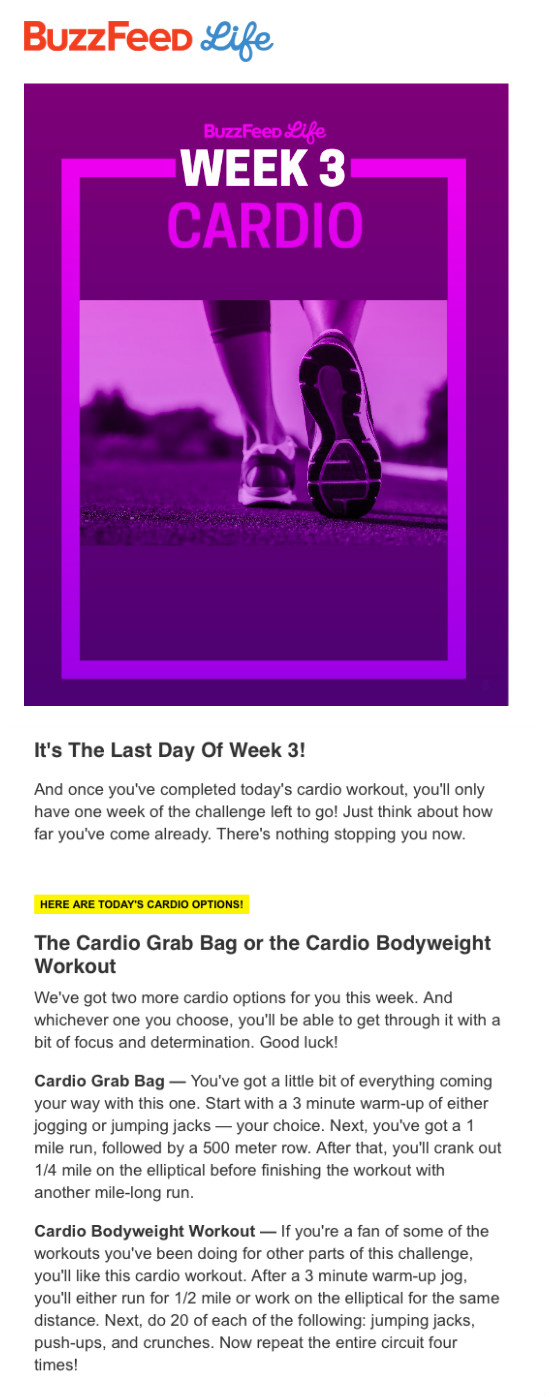
What works here: 

  • Be consistent with what you offered on the table. When you produce incredible content that people want to engage with overtime, you win. Send stuff out at random, and your subscribers might just hit that unsubscribe button!  
  • Create a cohesive look and feel. Use a color scheme that represents your brand and ensure all emails have the same look and feel that enables your subscribers to recognize you easily.  
  • Break your words down into digestible, bite-sized portions. Nobody wants an essay, especially your subscribers, who’ve already got 150+ other emails sitting in their inbox. Keep headlines short and sweet! 

Setting up drip campaigns with elfo 

Are you ready to embark on your automation journey at elfo?

We’ve got all the right people, tools, and solutions to help you get started.  Tell us what you need and your digital goals are just a click away! 

How does an individual decide whether or not to attend a webinar? It is primarily related to the webinar invitation’s approach. The purpose of webinar invitation emails is to make it as simple as possible for individuals to confirm attendance and see what’s in it for them.

In this article, we’ll analyze the various components of a webinar invitation email and illustrate how to design the ideal email to promote your webinar.

6 components of a webinar invitation email

Great email campaigns come in many shapes and forms. However, a webinar invitation email usually consists of 6 key components – your subject line, banner image, header text, webinar introduction, webinar details, and call to action. Read on to learn how to optimize each component.

1. Catchy Subject Line 

The subject line for a webinar invitation should follow the same rules as any other email. It should not be excessively long in order to avoid being cut off by email clients. Additionally, it should clearly state the message’s subject and describe the content contained within.

  • Include in the subject line the word webinar to identify the message from the start:

Webinar Invite: How to kick-start your career in Management?

[Webinar] Achieve True Dimensional Accuracy in 3D Printing.

  • Add How to: state the practical use and knowledge the participant will learn from your event:

Learn How to Make Graphics from Scratch!

Tomorrow: How to give every client an extraordinary experience.

  • Set the suspense by asking leading questions:

Is IT right for you?

What to Do If Your GMB Listing Gets Suspended? [Live Q&A]

  • Introduce speakers, especially if their names are world-famous:

Webinar: Interview with renowned photographer Sean Conboy.

Zoom with Exhibit View Software with Kyle Newman, Esq.

  • If your event is free, focus on its availability:

We’re excited to invite you to our free webinar.

Free Webinar: Be your own boss & teach English online.

2. Banner Image

Here are a few webinar invitation email banner best practices: Ensure that your text stands out clearly against your background, that the banner contains all necessary information, and that it includes pictures of your hosts/guests. Additionally, you may want to include a call-to-action on your banner.

Even without reading the further agenda, this banner clearly states the purpose of the webinar and provides all details.

Email Marketing Platforms

Banner in webinar email invitation by DigiFabster

This is how you can combine several speakers within one banner.

Email Marketing Services

Banner with several speakers in webinar email invitation by Bitcoinira

For B2C companies, it’s better to include more visually appealing images that would rather cause an emotional response and demonstrate benefits of the offer: a fit athlete for a fitness workshop, a model with healthy skin for a beauty webinar, a delicious meal for a cooling masterclass.

Email Marketing Solutions

Banner for B2C webinar email invitation by Real Ketones

3. Header Text

Most people simply repeat the name of their webinar or the topic of their webinar in their header text, but this adds no value to your prospect. Instead, try appealing to your prospect’s pain point or emphasizing a benefit of attending your webinar.

Here are some negative examples:

  • Live Content Marketing Webinar By Company ABC
  • Join Our Live Content Marketing Webinar
  • 25th February 2019 – Live Content Marketing Webinar

And some positive examples:

  • Want To Skyrocket Your Content Marketing Conversions In 2019?
  • Figure Out Why Your Content Strategy Isn’t Working, Once And For All.
  • Discover Tried-And-Tested Strategies Used By Neil Patel And Brian Dean.

4. Webinar Introduction

Your webinar introduction serves as a prelude to your pitch as to why prospects should attend your webinar. Instead of focusing exclusively on the details, share what your prospects can expect from your webinar.

Here’s a negative example:

Join us for a content marketing webinar on 25th February 2019. The webinar will kick off at 9 am PST, and it will be hosted by content expert Neil Patel. We will start off with a 20-minute sharing session, and close with 10 minutes of Q&A from the floor.

And a positive example:

Ever wanted to pick Neil Patel’s brain, and learn the specific strategies that he uses to generate up to 1.2M readers PER blog post? Now you can. Join us at our content marketing webinar hosted by Neil, and stay tuned for the last 10 minutes, where we open the floor for you to ask him all your burning questions.

5. Details of the webinar

Each webinar email typically includes an event agenda – a concise summary of the event’s key takeaways. Here, you can provide additional details about the topics that will be discussed.

The more attendees and presenters at your event, the more detailed the agenda should be. While the webinar title may appear too broad, more specific topics can sound more relevant and elicit a stronger response. 

6. Call to Action

Finally, end with a Call To Action button that is linked to a webinar landing page. This is where your prospects will RSVP for your webinar. A CTA is a required element of any email you want to prompt an action with. It should be noticeable and convey a direct and understandable call. If you’re asking people to register for the webinar there’s no need to reinvent the wheel.

Interesting to note: studies have shown that Call To Actions written using first-person pronouns perform better than those written in second person pronouns, so instead of saying “Reserve YOUR seat”, “Reserve MY seat” might work better.

Here are some other variants you can A/B test:

  • Reserve my spot
  • Claim my spot
  • Save my seat
  • Save me a seat
  • I’m in!

elfoMAP webinar software gives you the best online experience with built-in design to nurture relationships with your contacts.

Best webinar invitation email examples to get inspired by

We’ve scoured the web, and found some of the best webinar invitation emails that you can draw inspiration from. Time to get those creative juices flowing!

a. Litmus Webinar – Simple, yet efficient design

The company’s name in the email header, a plain yet light email background with bold fonts, a bright banner, and a simple design all contributed to the endearing simplicity of the Litmus webinar invitation. The speakers’ bios, along with their pictures and the webinar agenda, were all mentioned explicitly in this webinar invitation email.

Email Marketing

b. Marketing Optimization week by Unbounce – Catchy Logo

Unbounce’s webinar invitation email stands out due to the company’s unique brand logo. This catchy logo was memorable owing to its special design. It showed the importance of the brand itself.  This week-long workshop was hosted by Unbounce and covered a variety of topics. Furthermore, the brand’s logo confirmed that the workshop would be presented simply and decently, leaving a lasting impression on the minds of the readers.

Email Marketing Automation Platforms

c. Typecast Webinar – Brand colored masterpiece

The colour scheme and fonts used in this webinar invitation email are consistent. This choice was made to reflect the company’s real name in its small form. Readers are used to seeing capitalization in the first word of a sentence, so this change of using lowercase letters can be an eye-catching strategy to grab readers’ attention.

Email Marketing Best Practices

d. Sumo Webinar – Masters of the catchy headline

When you talk about attending a webinar, the most significant cost which comes in mind is not money but time. It’s important to clearly describe exactly what the attendee will gain if they attend your webinar. An example of a webinar invite with a clear benefit would be something like:

“After attending our webinar, the strategies you learn could help you increase revenue by 50%.”

As soon as the reader gets the information about their benefit, the chances are higher that they respond quickly and participate in your webinar.

Email Marketing Automation Tools

BONUS: Sending a series of webinar invitation emails 

A well-crafted webinar invitation email can be extremely effective. Your take-up rates will skyrocket if you send a SERIES of emails (or an email sequence). However, I’m not asking you to contact each person who ignored your initial email. Engaging in such arduous activity makes no sense.

Set up an automated email campaign instead to send emails to those who did not open your initial email (or those who did open it but did not click/RSVP).

If you want to target the former (people who did not open), use EXACTLY the same content in your body email and simply change the email title. Isn’t that straightforward?

If you want to target the latter, you’ll need to get a bit more creative. I recommend using some humor here, for instance:

  • Email title: [Webinar] Don’t keep us hanging, because someone else wants that seat…
  • Email copy: Hey, {Name} – are you still interested in attending our webinar, where you’ll learn how to do X, Y, and Z? Slots are filling up fast, and if you don’t want that seat, somebody else does!

A final word on designing the perfect webinar email

In short, a strong webinar invitation is an essential component of a successful webinar because it serves as the entry point for attracting viewers and convincing them to attend your event. The packaging reflects what’s inside the box: a unique email header, a webinar or company logo, plenty of details, webinar content, a description, a webinar schedule, a colour scheme, and a design. That’s all it takes to successfully send out webinar invitation emails!

If you are ready to design your webinar invite, you can entrust our team to create your email with elfo’s Email Marketing Managed Services.

Company newsletters should not be taken for granted, even if they are “just” for your own employees and coworkers. They can be effective communication tools that keep your team informed, engaged, and entertained if you learn how to do them correctly.

Below you’ll find the pointers, examples, and company newsletter ideas that you can bring back to your team immediately.

Objectives of company newsletter

Before we get into how to write great company newsletters, it’s important to understand what these messages’ goals are and what elements define them.

Why do you want to send your employees newsletters? Employee newsletters are popular in a variety of departments, including Human Resources, Employer Branding, and businesses in general, for the following reasons:

  • To inform. Information intended for affected employees is distributed through company newsletters. Regardless of hierarchical rankings, the information included is relevant and useful for targeted departments and employees.
  • To break down silos. Aside from disseminating pertinent information to all employees, company newsletters can also be used to foster camaraderie among employees who may be separated by cubicles, team designations, or departmental assignments and thus lack a strong sense of everyday belonging.
  • Provide framing and an external narrative. Every employee has a family, friends, and social circle of their own. Explaining why businesses do what they do and providing an easy way for them to be proud and spread the word can be a powerful catalyst for word-of-mouth.
  • Reduce email overload. A company can use the company newsletter as a more efficient distribution of information rather than sending multiple notices, announcements, or acknowledgments to various departments and employee groups.
  • Work together with other communication channels. In addition to other channels, your newsletter can serve as a reference for company information. They can, for example, announce or recognize the accomplishments of a specific team or department. This is typically only found on an intranet, slack, or bulletin board posting.
  • Grease the wheels of employee onboarding. Getting new employees up to speed on what’s going on in the company is just as important for the organization as it is for the new hires. You want your new employees to feel like they’re already a part of the team as soon as possible. Not only because you require their help with one of your major projects. According to a recent study, an effective onboarding process can increase employee commitment by up to 18x. This is something that your company newsletter can help you with.
  • Get feedback and improve employee happiness. It’s easy to lose touch when teams work remotely, with a distributed team spread across multiple locations, or even when teams work in the same location but on different projects. Your company newsletter can assist you in learning more about your employees, maintaining their engagement, and retaining them for a longer period of time. Employee email surveys are an excellent method of gathering feedback. It is important to demonstrate your concern for your employees by acting on the issues raised. Email is one of the tools that can assist you in obtaining feedback and enhancing your happiness and retention.

Elfo MAP

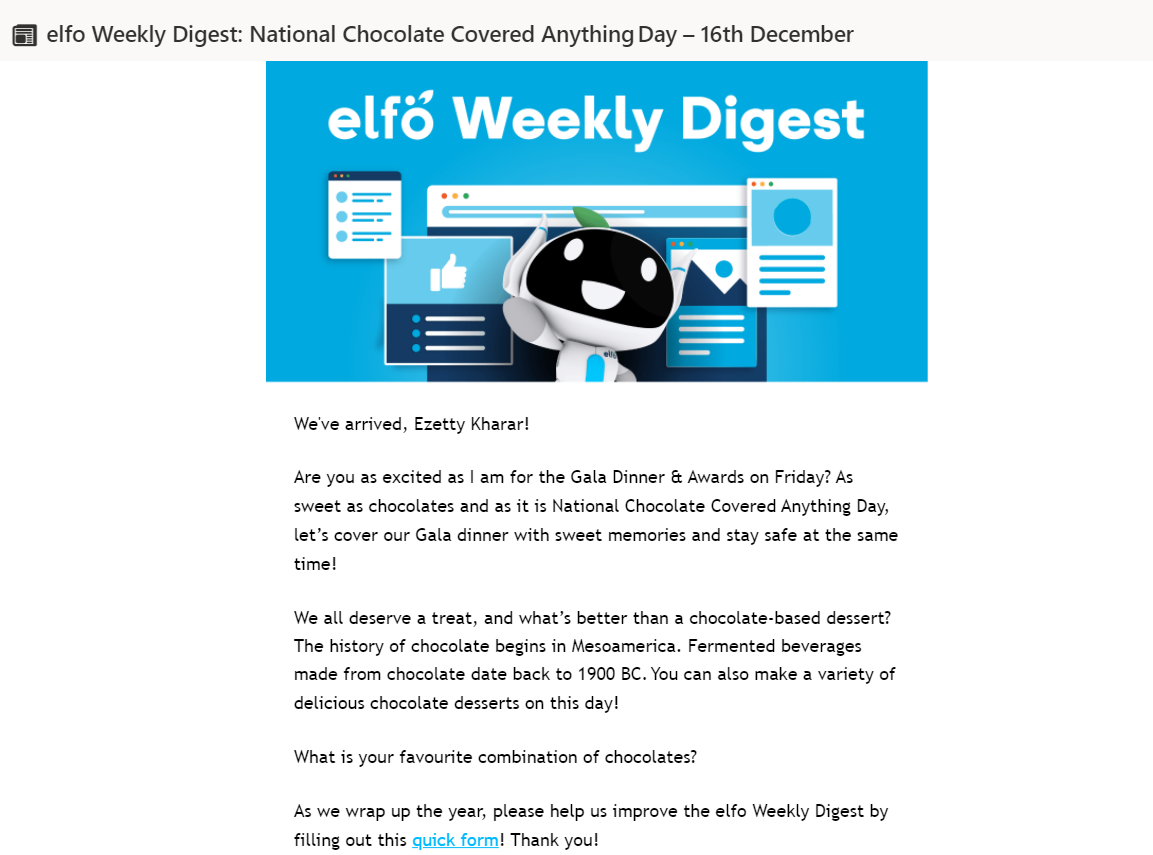
Example of elfo Weekly Digest Newsletter and asking for a feedback in a survey form

  • Improve your products and services. In your company newsletters, you can tickle your employees. Tickle them to give back fresh ideas through surveys – encourage them to participate in different innovative places. Workgroups, Brainstorms or Hackathons. Solutions to the challenges your company is facing are often found by anyone in the company. Email as a fire-starter to get valuable feedback from people across all departments. This includes employees who are not as prone to speak up by themselves or are hard to meet in the corridor.

Employee email engagement is a process that takes time. To accomplish this, you must maintain regular contact with them and make your emails interesting. It also has a bit of sass to it. It’s ideal to have a few “golden topics,” but to rotate them periodically to ensure that your emails are opened and read. Employee newsletters serve a purpose other than business. To jumpstart your internal communication efforts, here are 17 practical and enjoyable company newsletter ideas. The majority of them can be used independently or in conjunction with a company newsletter.

 1. Keep your employee newsletter short and sweet 

Today’s employees are receiving 88 emails a day, so it’s key that your internal newsletter gets – and keeps – employee attention. Your best option is to write shorter sentences that are easy to understand.

Keep the employee newsletter clean and minimal with great email design. For example, this internal newsletter from Stripo:

Email Marketing Solutions

2. Always provide value to your employees

Your employees should want to read your newsletter. The employee newsletter is your opportunity to take important company and employee news and tie a bow around it.

For instance, you could try these company newsletter ideas for topics: 

  • Include business updates 
  • Share employee news 
  • Report industry trends 
  • Provide links to the latest company blog posts 
  • Announce upcoming events 
  • Promote new customer stories or case studies 

Make your newsletter an indispensable part of your employees routine by consistently delivering important information in an easy-to-digest format is a surefire way to keep your employees’ attention.

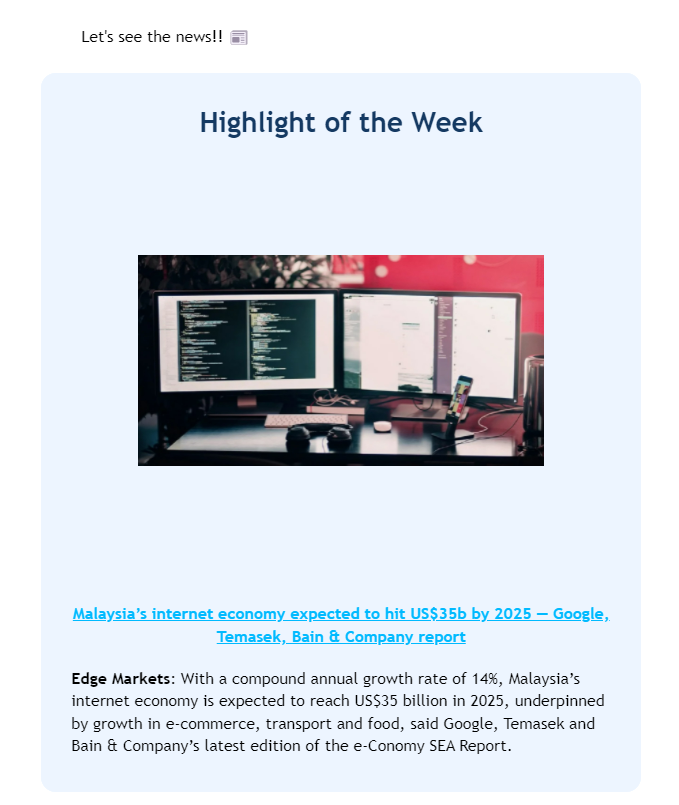
Do you have an internal company blog? Feature a round-up of the top articles featuring employees, product launches, and more within your internal newsletter. Here’s an example of elfo weekly digest newsletter that highlight news update of the week.

Internet Marketing Automation Software

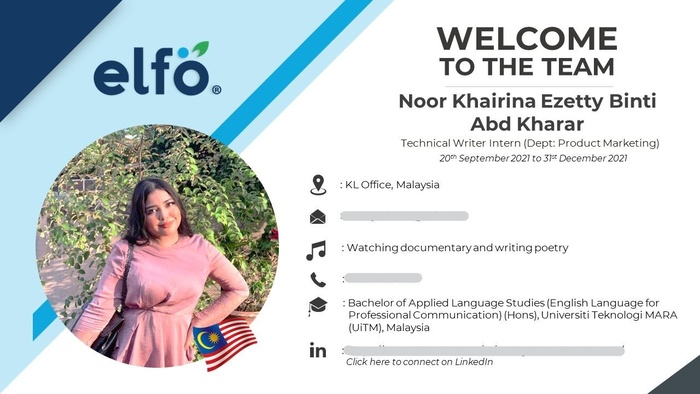
3. New team member announcement

Is someone new joining the team? Take this chance to present their profile and let them say a few words about themselves. A new member intro shouldn’t read like a resume. Instead, a personal angle usually works better. For example, think about their hobbies, an interesting book they’ve recently read, their favorite music, or how they like to spend their free time.

This will help make a connection with colleagues. It will also encourage employees to reach out and talk to those who share similar interests and hobbies.

elfo newsletter

Ezetty, elfo Technical Writer Intern get to introduced herself in elfo newsletter

4. Commendable feats and milestones

Employees are continuously going above and beyond. Maybe they’ve accomplished something they can be proud of. Use the internal newsletter to notify everyone when a department or project team “accomplishes a remarkable task,” so they can act as an inspiration. For instance, build team spirit, keep employees motivated, and inspire others to contribute to the team’s success.

5. Team Spotlight 

Team spotlights are more common in the workplace, but they aren’t limited to large corporations. Introduce the team, including who’s on it, what they’re working on, and how others can contact them. People aren’t always aware of what other teams are working on, and they don’t always spend their days reading the company wiki. In short, a team spotlight can help your entire company (especially new hires) stay informed and feel like they’re part of something bigger.

 6. Team party 

These days, company retreats, parties, and getaways are very popular. Organizing your team is easy if you have a small group. However, if your company has a few hundred employees, some of whom work abroad, planning everything takes a lot of time and effort. You can avoid some of the hassle by including all of the details about what’s coming and what your team members need to join you on a trip in your employee newsletter. After the event, write a summary, send photos and videos, and solicit employee feedback to make your next company retreat even better.

7. Special day events

You can’t organize team getaways all the time. But why not bring the party to the team. By that, I mean organizing a special day at the office.

You can plan them around special dates, like International Coffee Day, Star Wars Day, or Read a Book Day. Or, you can create your own company events. Here’s an example of a year-end holiday party with elfo talents virtually in Teams:

Automated Email Marketing

8. Competitions and contests

Everyone has at least one (extremely) competitive coworker. However, a healthy dose of competitiveness is always beneficial. You’ll notice that employees have the same drive in their personal lives as they do in their professional lives. Why not use this as an opportunity to have employees compete in a race or other type of competition on behalf of your company? Organize competitions within your organization. 

It should also not be difficult to generate new ideas. Cycling, running, swimming, and other sports may be considered. These could be centered on other interests as well. Cooking, baking, photography, or demonstrating a skill are all examples of demonstrations. People are often surprised at how involved they can become, especially when it involves something they enjoy.

9. Surveys

Gathering feedback is important in all areas of business in order to succeed. On a daily basis, feedback is an important part of team interactions and development plans. An email or online survey is advantageous because it is quick and structured, and it allows you to learn about your employees’ opinions.

Inquire about anything, including company benefits, training opportunities, workplace satisfaction, or a recent company retreat. In addition, “idea box” is a more general term. Online surveys allow you to do something that face-to-face surveys do not: you can make them anonymous. Just make sure people feel safe sharing and aren’t judged based on the outcome.

10. Job openings

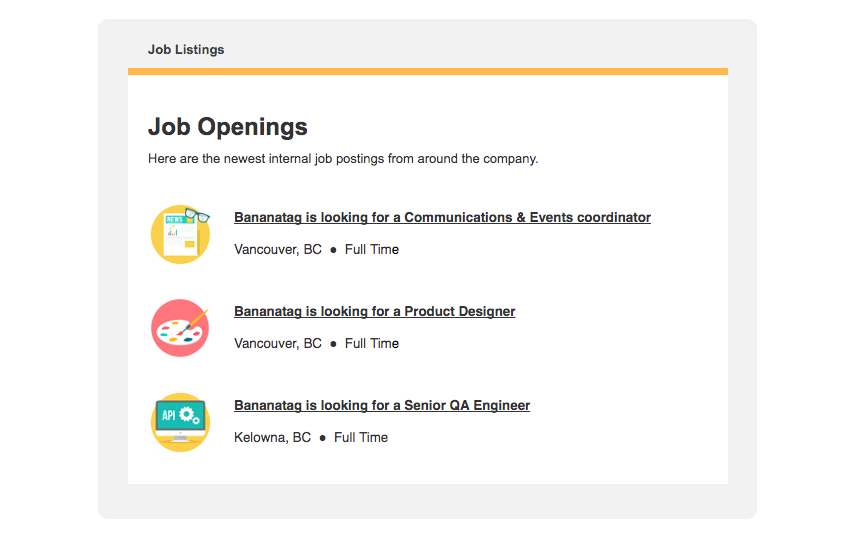
As another way to make your employee newsletters more valuable and engaging, include new job openings in them. We have a proclivity to associate with people who are similar to ourselves. So, if you’re pleased with your employees’ work attitude and performance, chances are their coworkers will be as well. This is especially useful in highly competitive industries (for example, IT Development) or when access to experts is limited. Here is an example of job openings from Bananatag newsletter:

internal newsletter

11. Training opportunities

Another way to help your employees thrive is to keep them informed about new training opportunities. 

This is a no-brainer if you’re already running workshops and trainings, that people can attend. But if you don’t have the budget to hire external trainers, you can try and start the initiative internally. Here’s an example of a workshop training by elfo:

elfoMAP

12. Naturally, all communication does not have to be about perks, benefits, or team outings.

After all, you are in charge of a company. As a result, internal email communication may also centre on issues affecting your company and industry. Send an email ahead of time to your employees if there are any legislative changes, an interesting trend that can help your business grow, or other important company news to communicate.

13. Updates on product and service development

Everyone in your team is affected by your decisions, so it only makes sense to keep them up to date on everything your teams have been working on. To effectively market your product, your marketing team must be aware of what is on the roadmap and what has been released.

If your Customer Service Team is up to date on the latest releases and services, they will be able to better assist your customers. Your sales team will be able to sell more effectively if they have answers or use-cases for your new features. The list could go on and on. It makes sense to keep customers up to date with new products and services. It also demonstrates that people do not need to rely on outside news to keep up with changes.

14. A (personal) message from the board or the CEO

An employee newsletter is a great way to share information about the company’s results, future plans, and forecasts. Because your employees must understand the direction of the company in order to follow the vision.

You won’t be able to meet with everyone one-on-one or even chat with them in the hallway if your company is large; you’ll have to find another way to communicate. For example, in your company newsletter. However, there are times when the news your CEO must deliver isn’t good and must be delivered as soon as possible. If something is having a negative impact on the company and its customers, they need to be aware of it so that they can prepare and understand the correct narrative (internal PR).

15. Sharing company’s history 

New team members require more than just guidance on how to do their jobs well, where to find information, and who to contact for assistance. They should also understand where your company came from, what values it promotes, and what its mission is. While much of that information is already available on your careers page, including it in your onboarding employee communications is a good idea. Sharing amusing photos of the company’s first office will help your new hires feel like they’re a part of the team.

16. Changes in company leadership / employees leaving 

Some companies are hesitant to talk about employee departures. However, in some circumstances, such as when a retiree is being bid farewell, it makes perfect sense to do so. Or when it’s someone in a key position, like the company’s adored evangelist/face of the company/that fantastic intern. When people change positions or leave the company, this is a good way to notify the rest of the company. 

17. Just for fun 

Fun may not appear to have a place in a company newsletter, but it may make more sense than anything else.

Including jokes, puns, and trivia can make your employees’ days brighter. If you do it on a regular basis, say, biweekly, team members may open your newsletter just to see that one segment.

Elements of effective employee newsletters

To write effective company newsletters, the following elements should be taken into account:

  • Target audience. Employees are the intended audience for internal newsletters. This may appear to be a single group, but this is not always the case. What do they want to know and what are they interested in? If you have a large company or a variety of interests represented, consider segmenting your content. On a departmental level, for example.
  • Content relevance. Each email newsletter should have a clear objective. As a result, align the content with the aforementioned objectives. However, readers should not feel as though they were wasting their time by reading (and responding to) your email. Alternatively, email marketing engagement will plummet after a few newsletters.
  • Presentation and format. To make newsletters familiar and easy to read/digest for everyone, use a consistent format. Internal newsletters benefit from having a consistent layout, style, and overall presentation. Use an email template that is both fixed and flexible. Why not plan it out in a grid format? It will save you a lot of time and effort if you get it right the first time.
  • Tone of voice and style. What the company stands for and how it sounds have a large influence on the tone of your voice and the manner in which you speak. It is important to choose a style that is appropriate for business. If you use the right tone, your newsletters will be more engaging and appealing. For example, a company like Red Bull may prefer a different tone than Starbucks, and these differ significantly from, say, a law firm, a non-profit, or the government. It can be lighthearted or serious and formal. A company newsletter is a tangible “representative” of the culture we frequently discuss.


Brand your business with perfect design. Try elfoMap Email Creator that comes with tons of ready-made templates and create professional emails that encourage engagement with your campaigns.

For many businesses, sending individual emails with a personal touch is great for building customer relationships, but it isn’t exactly a scalable approach. When the business grows, you’ll need a more efficient way to convert prospects into customers, and customers into loyal advocates.

Without the right tools, marketing to a growing list of customers can be quite challenging. A marketing automation platform can help overcome these challenges. Automating repetitive tasks such as email marketing will enable your marketing team to focus on delivering a more personalised experience for your customers.

Today, staying in touch with your audience at different stages of the customer lifecycle is only possible with a marketing automation platform. Let’s find out how marketing automation works to help businesses streamline their workflows and nurture multiple prospects at the same time.

Why Businesses Should Use Marketing Automation

Many businesses may be collecting more customer data than ever before, but it doesn’t necessarily mean that all that data is being put to effective use. Among the common challenges faced by businesses, generating qualified leads and keeping customers engaged throughout their journey remain top of the list.

When customers get in touch with your company, they may have a disconnected experience as they move from team to team across different channels. Creating healthy, long-term relationships with your customers is only possible when you can solve this pain point in the digital-first, omnichannel era.

Marketing automation can reduce this friction by gathering data in a usable format to inform teams at different stages of the customer lifecycle. When marketing automation is thoughtfully integrated, you can design a sales funnel with accurate touchpoints.

Convenience is What Marketing Automation Is All About

Automated Email Marketing

When done well, marketing automation can help businesses to cut through all the noise and reach customers in a timely and appropriate manner. Here are the key benefits:

1. Adjust and send more relevant content

You can create, develop and use buyer personas on a marketing automation platform to only send the information each prospect will be interested in. From the data you’re already been collecting, automation can highlight and send the most pertinent content at the right time.

2. Provide better answers, faster

When you unite the data siloes used by various teams, marketing automation can help your business manage leads better by answering incoming questions quickly. Direct access to data will reduce the amount of time employees need to dig around for information to provide the right help to customers.

It becomes much easier to understand your customers’ history and automate responses based on previous purchases and actions.

3. Offer seamless, omnichannel experiences

Nowadays, customers often jump from one channel to another, expecting to continue their sales journey seamlessly from the last channel they were using. People want to get the same customer experience no matter what channel they engage your business on.

A marketing automation platform can leverage the customer data your business has collected and stored to offer your customers a personalized experience, such as pre-filled forms on landing pages or targeted emails that meet their needs.

How Marketing Automation Works

Marketing Automation Software

Marketing automation uses software to automate all kinds of marketing work. When choosing the right marketing automation platform for your business, you should thoroughly understand what your needs are.

Look out for these essential features before starting your marketing automation journey:

  • CRM Integration

Whenever you collect information from your leads such as name, email, type of customer, and purchase history, it should be uploaded and stored in a database. Without access to these detailed records, all your marketing automation plans will fall through. All your automation activities must feed into this CRM tool before starting any campaigns.

  • Email Campaign Management

Thanks to marketing automation, email campaigns can be prepared, created, and scheduled months in advance. You can use advanced features such as A/B tests to improve the performance of your emails.

Depending on your customer interactions through other integrated channels, you can also have diverging email paths that can trigger more personalized emails. The ability to stagger large email blasts also boosts your SEO capabilities by safeguarding your company’s IP ranking.

  • Workflows

The most important feature of marketing automation is the ability to create workflows to support your marketing campaigns. Workflows are simple coded instructions joined together to guide all your automation processes.

Each instruction completes a task on a specific trigger, such as sending a follow-up email to customers after they have subscribed to your company newsletter. Experienced users can create complex workflows that send one of several emails based on an extensive set of criteria. To demonstrate their effects on the entire marketing campaign, visual dashboards are made available to map these workflows.

The best thing about creating workflows is that it requires no coding knowledge! You have the choice of either creating them from scratch or selecting from templates provided by the platform. Additionally, they are easily modified with a few clicks before or during a campaign.

  • Statistics and Reports

Metrics are the way to gauge the success of marketing automation. Ensure that your marketing automation platform has a powerful and easy-to-use analytics dashboard that helps you visualize open rates, CTR, conversion rates, and more. This will inform the next steps to take in your marketing automation strategies.

If the platform comes equipped with advanced segmentation tools, businesses can use the integrated data to improve their customer segmentation strategies. Detailed analytics such as conversions, CTR, and website statistics inform new criteria for customer segments. More precise segments enable your marketing team to boost the personalization of every customer interaction.

  • Budget Management

Resolving the age-old dilemma for marketing departments, a marketing automation platform helps you manage your budget spend. When linked through the CRM tool and an integrated accounting system, campaign costs can be updated in real-time with every proposed adjustment.

  • Landing Page Builder

For certain marketing campaigns, a landing page may be required. Some marketing automation platforms allow you to generate simple landing pages with a sign-up form for interested prospects. Whether hosted on the main site or hosted independently, these landing pages can be tagged with tracking URLs.

Make it as convenient as possible for your marketing team to create landing pages for your customers to sign up and download your content. elfoMAP has a simple drag-and-drop interface that lets you create marketing campaigns tailored to your specific promotions.

Marketing Automation Best Practices

Marketing Automation Strategy

Here are some best practices to keep in mind when designing your marketing automation strategies:

1. Collaborate with other teams.

Several teams in your company will be involved in bringing your marketing automation strategy to life. Get their input and buy-in before you begin.

2. Create process visualizations.

To effectively convey the ultimate objectives of your plan to your management, use detailed diagrams of your marketing automation workflows.

3. Prepare for customer segmentation.

Consider your customer data carefully. Think about who you’d like to engage, how and why.

4. Prepare your content strategy.

Creating interesting, engaging, and relevant content and messaging to reach all stages of the customer lifecycle will be one of the activities your marketing team will now have more time to commit to.

5. Analyse as you go.

As you run multiple campaigns concurrently, you should be observing what’s working and what’s not. Check your analytics from time to time and make the changes that will grow your business.

Key Takeaway

Automation helps businesses complete time-consuming marketing tasks and puts the huge amount of data gathered through multiple channels to work in realising optimised marketing campaigns.

Now you know how marketing automation works. Are you ready to take your marketing strategies to the next level and improve your customer experience? Why not sign up for elfoMAP! Email marketing can be made easier with the right suite of design and support functions.

Email marketing comes with its own set of vocabulary that businesses need to familiarise themselves with. When you’re just getting started with email marketing, you’ll quickly notice that there’s some new terminology to learn. A common term that you’ll hear quite often is “bounced email.” What does this phrase mean?

This article is intended for business owners who want to improve their email marketing strategy’s effectiveness. Let’s take a look at what a bounced email is, how to differentiate between hard and soft bounces, and why keeping your email bounce rate low is important for your sender reputation.

What Does Bounced Email Mean?

If any of your emails doesn’t reach its intended recipient, it ‘bounces’. This means that the email was rejected by the recipient email server, either temporarily or permanently. Usually, you’ll receive an auto-response when such delivery failures happen, informing you that your email bounced.

Soft Bounce vs Hard Bounce Email

An email can bounce for different reasons and these differences are usually defined as either a soft or a hard bounce. Understanding the differences between soft bounce vs. hard bounce emails can help you identify what to improve upon for your email marketing efforts.

Hard Bounce

A hard bounce is an email that cannot be delivered due to permanent reasons that cannot be fixed. A hard bounce typically occurs when the recipient’s email address is invalid or no longer in use.

In some cases, the person could have accidentally mistyped their email address when filling up the subscription form for your business newsletter.

Common reasons for a hard bounce to happen:

  • Fake or non-existent recipient email address.
  • Fake or non-existent email domains.
  • Outdated email list.
  • Rented or paid-for email list.

You want to avoid getting hard bounces as much as possible because they can hurt your email deliverability rate and sender reputation. We’ll get to that later in this article.

Related topic: How to Easily Collect Email Addresses for Free

Soft Bounce

A soft bounce is an email that was not delivered due to a temporary problem. Unlike a hard bounce, a soft bounce is an email delivery issue that can be fixed.

Common reasons for a soft bounce to happen:

  • Full mailbox (over quota).
  • Inactive mailbox.
  • The recipient email server is down or offline.
  • Content in your email message is blocked or too large.
  • Your email message does not meet the recipient server’s policies.
  • Your email message does not meet the recipient server’s DMARC requirements for authentication.
  • Your email message does not meet the recipient server’s anti-spam requirements.
  • Your email message does not meet the recipient server’s anti-virus requirements.

If it is any of the above reasons, most email providers will try and resend the email a few more times. However, if the email continues to see delivery failure, consider that recipient address a bad one and remove it from your list.

On the elfoMAP platform, you can easily check your email lists for common issues as they are imported. Here, you can find out when an email address is no longer active, is misspelled, or when the recipient wants to unsubscribe. elfoMAP can be set to automatically remove these from your list so that your email deliverability rate isn’t affected.

Related topic: How to Ensure Your Emails Avoid Spam Filters

How to Calculate Email Bounce Rate

email bounce rate

As your business continues to grow its mailing lists while carrying out bigger email marketing campaigns, it is inevitable to see a number of bounced emails. However, a high bounce rate is a real problem.

On average, your bounce rate should be no more than 2%. If you can get it to a lower percentage, the better your sender reputation will be.

Here is the formula used by marketers to track email bounce rate:

(Bounced emails ÷ Total emails sent) x 100 = Email bounce rate

What Is Sender Reputation And Why It Matters for Your Business

Unique to email marketing, sender reputation is a metric that analyzes the quality of your mailing list based on what email practices your business follows. How often your emails bounce can affect this data.

Internet service providers (ISPs) use this data to assess whether or not recipients should accept emails from certain addresses. If it is determined that the email address your business uses has a poor sender reputation, your emails will frequently bounce back or automatically filter to the spam folder.

Thus, the best way to reduce the number of bounces is by following key email deliverability best practices. This article provides a comprehensive list.

Soft Bounce vs Hard Bounce Email: Key Takeaway

Email marketing offers small businesses a great opportunity to build relationships with their target audience and achieve high ROI. Growing a healthy email list is an essential part of building your business, but it comes with its own challenges to be mindful of.

The credibility of your sender reputation can quickly deteriorate if you get too many bounced emails. You don’t want to do the hard work of building an email list only to end up with a high bounce rate.

It isn’t possible to prevent bounced emails entirely, but you can limit the number of hard bounces you experience. Reduce your email bounce rate by entrusting all your email marketing campaigns to a platform like elfoMAP to improve customer engagement and get successful outcomes.

Pick up a free trial of elfoMAP today to help your brand reach its full potential!


Are you concerned that your emails may not reach your customers’ inboxes? That your business line will suffer as a result of how spam filters assess your messages? Perhaps you’ve already noticed that your emails are being sent to spam rather than your inbox and are looking for assistance.

Don’t worry if you nodded at any of these. We’ve got you covered! This article will not only answer the main question – why do emails go to spam? – but will also suggest strategies to assist you boost your inbox placement rate.

So, without further ado, here are the 12 reasons why some emails end up in spam and what you can do to avoid this in the future.

12 reasons why emails go to spam and what you can do about it
Email Marketing Solutions


1. You don’t have the permission to contact your recipients

Although email marketing has always been permission-based, regulations and the definition of “consent” vary by country.

Because of these distinctions, you’d often hear about marketers who downloaded an email list from the Internet or purchased it from another company, then thought it was fine to send them marketing emails as long as they had the option to unsubscribe. That, however, is no longer sufficient.

Before you begin sending email campaigns, always ensure that you have permission to do so. If you fail to do so, you risk not only having your emails routed to spam, but you may also face a fine.

That’s why if:

  • you’re still filling your email campaigns with contacts from Outlook, Gmail, LinkedIn, or any other place where you’ve interacted with people,
  • you’re an ecommerce business automatically adding people to your list from the checkout page,
  • you’re using a pre-checked newsletter consent checkbox in your web form,
  • buying or downloading email lists from the ‘reputable sites’…

…you should stop right now.

If you’re unsure whether it’s appropriate to contact some of the people in your database, consider running a reconfirmation campaign. By sending an email in which you explicitly ask your audience if they want to remain on your list, you can ensure that only those who are still interested in your offer will remain on the list.

Not sure what these looks like? Here’s one example we’ve received when GDPR came into force:
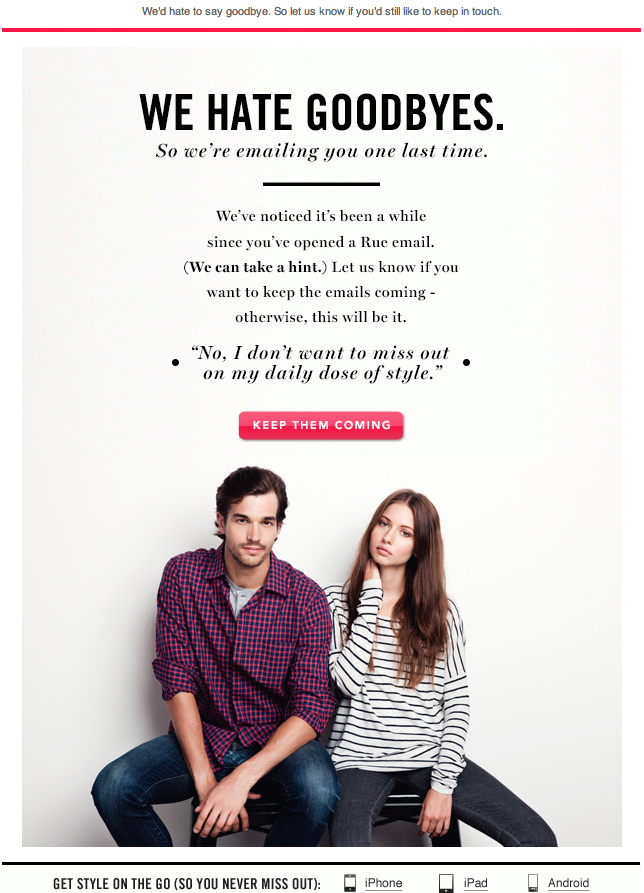
Email Marketing

Reconfirmation email sent right before GDPR came into force by Rue La La

Pro tip 1: Manage a consent field in your email campaigns. These will allow you to easily store, manage, and view all of the permissions that your contacts have given you.

Pro tip 2: To improve your inbox placement rate and avoid having your emails reported as spam, always exclude (or suppress) contacts who haven’t given you the proper consent. This is especially important if you have contacts in your database who have not agreed to receive marketing emails.

Pro tip 3: If you’re sending the same message to multiple marketing lists, see if your email service provider skips duplicate email addresses automatically. Because not all platforms support it out of the box, use caution if you don’t want to send the same message to your target audience multiple times.

2. It’s not clear what your subscribers are signing up for

Transparency is key, especially when it comes to building your customer base. Users should be fully aware of the type of communication they will receive in the future when filling out your sign-up form.

Make it very clear what you intend to discuss in your emails and then deliver on that promise. When you do this, you will notice that your unsubscribe, and complaint rates will drop. And your sender reputation will improve.

Pro tip 1: Make sure your web form, thank you page, and welcome email all clearly state what your users are signing up for. Doing this early in the subscription process increases your chances of developing strong relationships with your target audience. In addition, your emails will be less likely to be marked as spam.

Take a look at this example from a brand called Nerd Fitness. Throughout their sign-up form, thank you page, confirmation email, and subscription confirmation page they’ve made it clear what their newsletter is about, how frequent their communication is, and how the subscriber can make sure to receive the communication in their inbox. Here’s an example from Nerd Fitness:
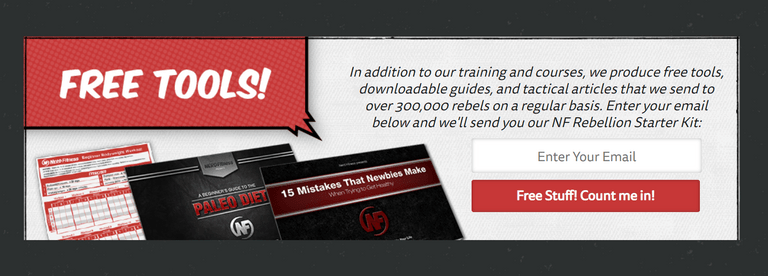
Email Marketing Automation Tools

Step 1. Sign-up form from Nerd Fitness explaining what we will receive once we subscribe to their newsletter
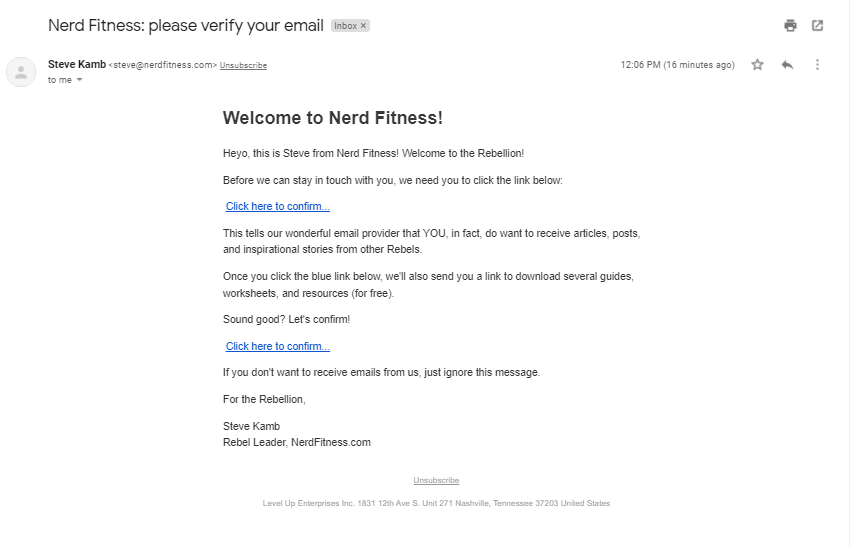
 

Email Marketing

Step 2. Confirmation page telling you that you need to click the confirmation link
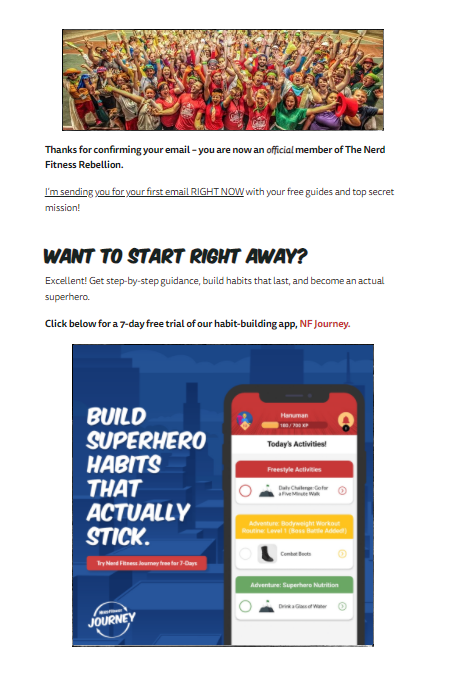
 

Email Marketing

Step 3. Subscription confirmation email
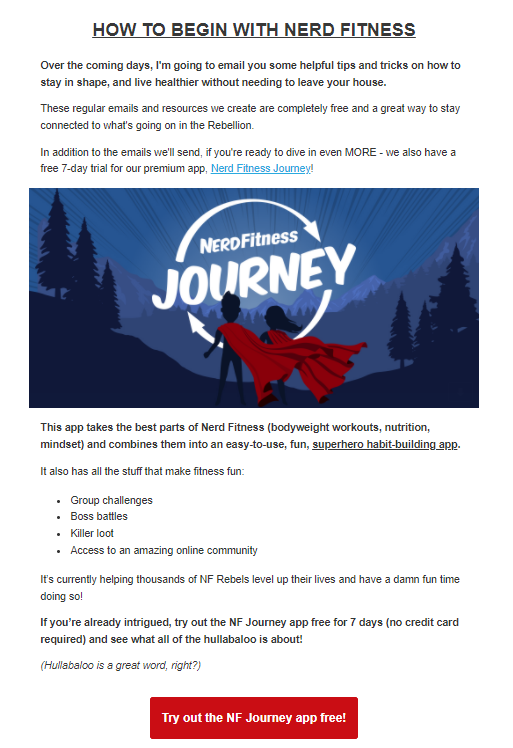
Email Marketing

Step 4. Newsletter subscription confirmation page welcoming new subscribers

Pro tip 2: If you want to lower your unsubscribe rate a good idea might be to fill out your email list description visible in your subscriber’s preference center. This will help your audience decide which lists they want to stay subscribed to and which ones they want to opt out from.

3. You’re making it difficult to unsubscribe

This is a major red flag and one of the most common reasons subscribers report emails as spam.

If someone wishes to discontinue receiving marketing communications from a specific sender, the last thing they want to do is waste time looking for a way to unsubscribe. When they find it difficult or lose faith in the message’s ability to be processed successfully, they report it as spam or manually move it to their spam box. The marketer is at a loss in both cases.

Here are some things you should avoid:

  • burying down the unsubscribe link below the main part of your footer (e.g., by adding empty lines on top of it),
  • hiding the unsubscribe link (e.g., by changing the copy or writing in a hard-to-read color),
  • making your recipients contact you to resign from the newsletter,
  • making recipients log into some form of a panel to unsubscribe or change their mailing preferences,
  • taking unreasonably long to process your users’ requests to unsubscribe.

Adding any of the above roadblocks just pushes your emails closer to being marked as spam and being negatively evaluated by Internet Service Providers’ (ISPs’) spam filters.

Pro tip 1: If you’re concerned about an excessively high unsubscribe rate, consider giving your subscribers the option to opt out, reduce the frequency of your mailings, or even pause them for a set period of time (e.g., 90 days).

You can divide your recipients into different groups by using a separate email list or segment or include a brief explanation of why the subscriber is receiving your emails and a reminder of when and how they signed up for your newsletter.

Pro tip 2: If you’re receiving a lot of spam complaints despite following the tips in points 1-3, you could try including an additional unsubscribe link right after the preheader text inside your email message.

This may appear to be a radical move, but having more people unsubscribe from your list is preferable to having them report your messages as spam.

Improve your email deliverability and start sending email campaigns that make the cash register ring with elfoMAP!!

4. You’re not using the right email marketing software

I know it sounds like we’re blowing our own horn, but it’s impossible to overlook an important factor–your email marketing software. Your email service provider also plays an important part in delivering your emails to your subscribers’ inboxes.

Let’s take our example.

Here, at elfoMAP manages your IP reputation, handles bounces, unsubscribes, spam complaints, and creates feedback loops.

Thanks to this, we know when an email address is no longer active, is misspelled, or when the recipient wants to unsubscribe. When we come across such addresses, we remove them from your list so that your deliverability isn’t affected and you don’t have to pay extra for contacts that aren’t useful to your company.

In addition, we check your email lists for common issues as they are imported, automatically assign engagement scores to your contacts to make reengagement campaigns easier, and assist with custom DKIM configuration if you use your own domain.

Pro tip 1: Email authentication is another option worth investigating. Setting up SPF, DKIM, and DMARC will identify you as a recognizable sender to the ISP. By identifying you, they can ensure that you are not impersonating anyone else. It will also assist you in increasing your domain and IP reputation, as well as making all of the good things you do “stick” to your brand.

Pro tip 2: While designing and coding your own emails from scratch works for many out there, one of the common reasons why emails go to spam is that their HTML code isn’t clean.

To avoid that, either hire a developer who’s on top of the email design game specifically (coding for email is very different from coding websites) or use an email maker.

5. You’re sending your email campaigns from a freemail domain (e.g. Gmail or Yahoo!)

Marketers who are just starting out with email marketing often use freemail domains like Gmail or Outlook to send out their newsletters. While it is not illegal, we do not recommend it.

Bulk emails from freemail domains such as Yahoo!, AOL, Gmail, or Mail.ru are often rejected by mailbox providers. ISPs would prefer to receive messages from domains registered by an individual sender, whom they can track back and whose reputation they can evaluate. Tracking down the individual sender is obviously impossible with freemail domains, which may explain why they are frequently abused by scammers and people who want to send out spam on purpose.

So, what should you do instead? All you need to do is create your own company domain or a subdomain under your existing domain to use for email campaigns.

Even if you only use it in the from address and not the mailing domain from which you’re sending your messages, it will help you deliver your message more effectively.

Pro tip: Using tools like the elfoMAP will help you identify such common mistakes as the freemail domain in your from address. By running your newsletters through a spam checker, your chances of reaching the inbox grow considerably higher.

6. Your email frequency is off

As a general rule, you should avoid blasting emails to your entire customer base and instead take a more structured approach. However, we’ll get to that later in this article.

Pro tip 1: Determine the appropriate email frequency by compiling your key email marketing metrics (such as total number of conversions, unsubscribe rates, and bounce rates). Once you’ve determined the best email schedule for your audience, make sure to communicate it to them, for example, in your subscription form or the welcome email.

Pro tip 2: To increase your email frequency without alerting spam filters, begin by contacting your most engaged subscribers first. Suppression lists can be used to exclude segments that are less likely to respond to your email campaigns.

After you’ve successfully engaged your best recipients, you can gradually begin to include those who read your newsletters less eagerly.
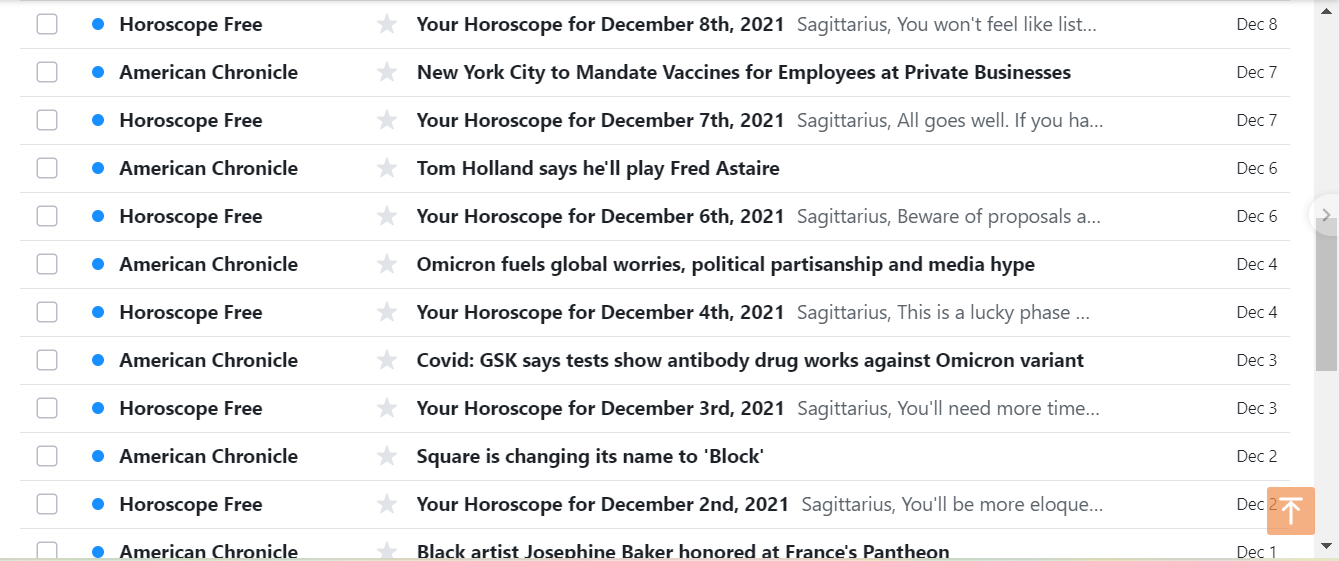
Email MarketingSome email marketers may get away with sending out a lot of emails. Even the name of the newsletter suggests that it is a daily newsletter update in this case. This method, however, should be used with caution because it has the potential to backfire. Users can become overwhelmed if they receive too much communication. This will result in an opaque churn. In other words, they will not unsubscribe from your communication, but by ignoring it, they will negatively impact your total email deliverability.

7. You’re not paying enough attention to email list hygiene

Email list hygiene management entails identifying engaged subscribers, re-engaging those who have become unresponsive, and getting rid of those who hold no business value.

And whom do we mean, when we’re saying that they’re holding no business value? Not just those who no longer engage with your communication, unsubscribe, or mark your emails as spam. We also refer to those who have provided incorrect or fictitious email addresses, as well as those who have abandoned their mailboxes.

You might think that this isn’t such a big deal. According to a recent Return Path study, marketers lose 44% of their new subscribers within the first year of their subscription. And if a significant portion of that churn goes unnoticed because people don’t actually click the ‘unsubscribe button,’ we’re looking at a possible reason why your emails end up in spam.
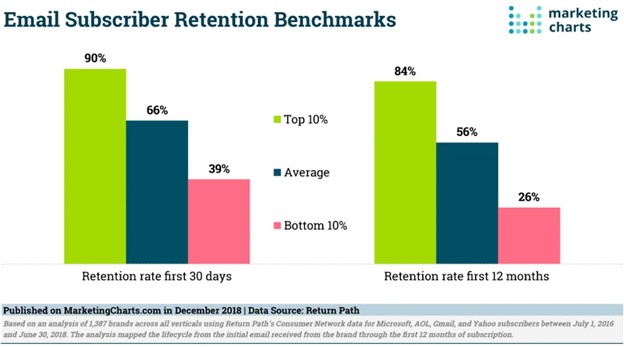
Email Marketing

So, what should you do? To keep your list clean and hygienic, ensure that your entire list building process is flawless. That your data is properly collected and transferred to your email marketing software, and that you ideally use confirmed opt-in (a.k.a. double opt-in).

Consider this: the more effort you put into this process ahead of time, the fewer problems you’ll have in the future regarding bad data, human errors, and low inbox placement.

Pro tip 1: If you haven’t cleaned your list in a while, or if you haven’t processed bounces and unsubscribes, you should start now. The best way to accomplish this is to use an email verification tool and set up an automated re-engagement campaign that will send a couple of emails to those identified as inactive by the system.

You can easily do this entirely in elfoMAP. elfoMAP includes marketing automation templates that you can use to run such a campaign.

8. Your emails are image-heavy (but not text-heavy!)

Email marketing differs slightly from other marketing channels. Although images are important, they should not be the focus of your newsletters.

Many email marketers make this mistake: they overcrowd their email templates with images in order to make them look nicer and spend less time writing sales copy. This may seem like a good strategy–after all, people like images and can read the text even when it’s part of an image.

But there are two problems with this approach.

One is that, unless you provide the ALT text to your image, consumers that use screen readers may have trouble reading your content. Plus, with so many email clients blocking images automatically messages that don’t have the ALT text provided look rather unappealing.

The second is that ISPs such as Gmail and Outlook view this differently. Many heavy images result in heavy emails, and ISPs want to process as many emails as possible. By making your newsletters image-heavy, you make the process more difficult and resource-intensive. As a result, they may choose to filter your messages less favorably, sending them to the spam folder or even bouncing them.

In general, the more text there is or the higher its ratio to images, the better.

So, what should you do when images are required in your email template?

First and foremost, determine whether your email service automatically reduces the size of images you upload to your newsletter.

When you add your own images to an email template in elfoMAP, for example, you must first load the image editor and save the images to have them cropped and compressed. This is not the case for GIFs, which must be edited outside of the platform using tools such as Ezgif.

Pro tip: Adding more copy to your footer is one way to boost your text-to-image ratio. You could explain why your subscribers are receiving the email, who is sending it, and how they can manage their mailing preferences or unsubscribe from it there.

You can also boost your text-to-image ratio by including copy (in text, not over an image) in your email introduction and product descriptions. The same is true for creating call to action (CTA) buttons, which can be coded and styled to look almost identical to what your designer would create.

9. You are directing traffic to dubious websites (among other things)

Many email marketers are unaware that when ISPs and spam filters analyze your email’s content, they also look at your links.

Here are a few things to avoid if you’re trying to improve your email deliverability because it’s being flagged as spam:

  • linking to websites with a poor domain reputation
  • use links that repeatedly redirect users
  • use dubious link shorteners
  • with a low text-to-link ratio
  • linking to an excessive number of different domains

Keep in mind that your links may be hidden in the images you use. If they’re hosted on a website with a bad domain reputation, email spam filters may pick them up. Overall, you should double-check the websites you’re linking to and the number of links in your email. Again, a higher text-to-link ratio is preferable.

Pro tip 1: Before hitting the send button, run your emails through a spam checker. This way, you’ll be able to pinpoint the problematic section or individual element. It could be a single link or a section of your copy, so pay attention to all elements in your email template.

Pro tip 2: If you want to lower your spam score even further, you can include the plain text version of your message in your email template. Why bother including it?

Because it is one of the factors used by ISPs to determine the legitimacy of your email campaigns. It is also useful for those who prefer to read emails in their non-HTML format.

10. You’re playing dirty

Some marketers will do anything to increase their email open rates and get a chance of receiving a click on their link. What they often don’t realize, however, is their tactics leave their customers at loss. And even if there’s any short-term gain for their business, it often has a long-term impact on their whole email marketing program.

What sort of tactics are we talking about? For example, adding phrases like “Re:” or “Fwd:” to their subject lines. Adding these elements is meant to trick the subscribers into thinking that your marketing email is just a regular massage they’d receive from a friend or colleague.

Naturally, newsletters and other marketing communication don’t work this way. Although they do include personalization or a friendly from name, they’re not meant to trick people into thinking that they’re sent from an individual person in response to their previous email.

How about using the so-called spam trigger words? You know, words like “buy now” or “free”. Believe it or not, most lists of “words to avoid” are now obsolete. Spam filters have evolved so much, they don’t just look at the direct use of common phrases like the ones above. Using phrases like “cheap” won’t move your emails into the spam folder.

Pro tip: Now that spam filters have become more complex, your main focus should be on increasing your email subscribers’ engagement. One of the best ways to do this is to use email automation. Automated emails are sent in response to your recipients’ actions and preferences, which is why they generate above-average open and click-through rates. There are of course other ways to increase your engagement, but we’ll go over that in a moment.

11. Your email engagement rates are low

If you’re seeing that your average email marketing metrics are below the email industry benchmarks, there are a few things you should do.

First of all, focus on improving your email list hygiene. As we’ve discussed in point #7, it’s critical to keep your list clean from bad or inactive email addresses. That’s why you should regularly run re-engagement campaigns that’ll reactivate and separate inactive recipients from your most loyal readers.

The second thing you should consider is lead nurturing. Instead of throwing your new subscribers into the same stream of communication everyone else receives, you should treat them in a more special way. By designing a drip campaign, you can turn your new contacts from complete strangers to active consumers one message at a time.

Welcome emails will play a significant role in your lead nurturing campaigns. They are excellent not only for making a good first impression, but also for engagement and deliverability. It’s also easy to set up welcome emails. All you have to do is set up an autoresponder or a marketing automation workflow that will be sent immediately after a new contact is added to your list.

Last but not least, make sure to segment your audience for all major campaigns. Rather than blasting emails to everyone on your list, target the customer segments most likely to be interested in your offer.

You could base this on the customer attributes they provided when signing up for your list, or you could look at their previous behavior and identify only those who are engaged in your communication. By going for the more targeted approach, you’re likely going to see higher engagement rates and won’t need to worry about missing the inbox any longer.

Pro tip: Increasing your email engagement rates takes time. If your messages mostly land in the spam folders, start sending your email campaigns to only your most engaged audience. Once you’ve managed to reach them, slowly begin to go for the slightly less engaged ones and ideally skip those who are completely unengaged.

As mentioned before, in elfoMAP we evaluate your subscribers’ activity and assign them different engagement scores automatically.

12. Your mailing IP has a bad history record

If you’ve gone through all of the aforementioned reasons, fixed them, and your emails are still ending up in the spam folder, your mailing IP is most likely to blame.

The IP address through which you send your email campaigns develops its own reputation. And this reputation sticks with that IP address for months, even if no one is using it to send email campaigns.

Most email marketing providers (including elfoMAP) use a number of shared IPs to process your campaigns, so this isn’t usually a problem. In other words, a number of marketers work together to build a brand’s reputation. Furthermore, email traffic is routed through various channels to ensure that deliverability is maintained.

Having said that, if you’re having deliverability issues and are using your own mailing IP, you should look into this further.

Note: It’s also possible that your IPs’ reputation gets affected by someone else who’s sending their campaigns from an address within the same IP class. This is rarely the case, but if all else fails, you should look into the reputation of addresses in your IP class.

Pro tip: If you’re thinking about using a dedicated IP address to send out your campaigns, find an email service provider that offers full support.

Get out of the spam folder right now.

It’s time to start improving your email deliverability now that you’ve learned the 12 reasons why your email campaigns may be going to spam rather than the inbox and how to be seen as one of the great email senders.

If you’re ready to migrate your campaigns to an email marketing tool , sign up for elfoMAP!


TRY elfoMAP FOR FREE!