Email marketing may not be the trendiest or newest marketing channel, but it’s still a vital way to generate leads and convert more prospects for your business.

elfo wants to share a number of email marketing best practices your business can use to meet the expectations of your target audience and grab their attention.

elfo’s Email Marketing Best Practices

  1. Use a personalised sender name.
  2. Have a real reply-to address.
  3. Do not buy email lists.
  4. Get recorded permission before sending emails.
  5. Ask for subscription twice.
  6. Segment groups in your email list.
  7. Clearly inform people who join your list what to expect from you.
  8. Reduce dormant subscribers to reduce bounce rate.
  9. Make sure to insert an unsubscribe link in every email.
  10. Avoid spam trigger words in your subject lines.
  11. Avoid including playable media content.
  12. Avoid embedding forms.
  13. Avoid including attachments.
  14. Reduce the number of images for quick load times
  15. Double-check spelling and grammar.

elfo, digital marketing

For email marketing, remember that your primary goal is to build a solid relationship with your customers. It’s not enough to just grab their attention; you need to do more to secure their trust.

1. Use a personalised sender name.

When sending your emails, use a sender name that preferably contains your personal name so that recipients quickly recognize you. An email address like firstnamelastname@domain is appropriate, NOT an obscure one like 1234vds@domain. What’s the reason for this?

People are bombarded with emails every day so they usually comb through their inbox and open the interesting ones. In most cases, people tend to open those which include a personal name in the ‘from’ box because these are easier to identify immediately amongst the sea of impersonal, generic ones.

Another good reason to stick to only using a personalised sender name is that leading email service providers actually pay close attention to the ‘from’ field. Today’s spam filters have reputation-based filtering that gathers information about the source of the email (IP address and domain).

2. Use a real reply-to address.

When creating your next email campaigns, try to avoid using emails like [email protected] as the reply-to address. While you may not require recipients to respond to certain emails you send them, email addresses like this imply to people you are not interested in hearing from them.

If you use this kind of address too often, it will prevent your company from receiving the engagement you want from email marketing by reducing the number of valid responses you get. Using friendlier-sounding email addresses encourage people to respond. Here are ones that a lot of companies typically use:

Read more: How to Onboard New Customers with Welcome Emails

3. Do not buy email lists.

It’s always safer, smarter, and healthier for your business’ reputation to build an email list from scratch.

Arguably, the biggest offense you can commit is buying email lists because sending your emails to addresses you didn’t obtain legitimately is wrong – plain and simple. Legally, it represents a violation of your Internet Service Provider’s Terms of Service.

Inversely, this means that selling or transferring email addresses (without permission) to other lists is also illegal. Don’t commit a violation of people’s privacy by buying lists as they never accepted to be contacted by you and this is a one-way ticket to be blacklisted.

Read more: How to Easily Collect Email Addresses for Free

4. Get recorded permission before sending emails.

No matter whether customers buy a product from your website for the first time or the tenth time, do not send promotional emails without getting their permission first. Have customers agree through a clear sign-up form on your website or give them the option to sign up for your newsletter after they make a purchase from your store.

5. Ask for subscription twice.

Even after their subscription, send your new subscribers a follow-up email asking them to confirm whether they do want to receive emails from you. If they really want to receive your content or offers, they won’t mind. This practice of double opt-in helps you to keep your list nice and clean.

6. Segment groups in your email list.

If you want to see better results from your email marketing efforts, don’t simply send the same email to every address in your list. Segment groups based on what they’re interested in so that you’re only sending relevant offers to the right people.

7. Clearly inform people who join your list what to expect from you.

Telling people what you’ll be sending and how often you’ll be sending emails establishes transparency and earns the trust of your subscribers early on. If you intend to send out various content (monthly newsletters, weekly special offers, etc.), create some options for people to choose what content they want to receive from you.

8. Remove dormant subscribers to reduce bounce rate.

During every reporting cycle, pay attention to subscribers who aren’t opening your emails. If it’s reoccurring inactivity, you should consider either launching a re-engagement campaign or remove these addresses from your lists. Why?

Because bounce rates are one of the important factors ISPs keep track of to determine your sender reputation. Inactive subscribers contribute to this statistic and it might damage the reputation of your company’s domain which directly influences deliverability rates.

9. Make sure to insert an unsubscribe link in every email.

Sometimes people lose interest in your content or offers; it happens. If they want to unsubscribe from your mailing list to stop receiving your emails, you must let them go.

Simplify the journey by putting an unsubscribe button at the bottom of your emails. Never try to email the same addresses again unless they sign up for a new subscription. If you continue to send them emails, you will most likely be marked as spam, bringing down your sender reputation.

10. Avoid spam trigger words in your subject lines.

Pay attention when crafting the wording of your email subject lines. There are certain words and phrases that set off spam filters and if you use them often enough for your emailing campaigns, it may get you blacklisted, owing to their association with real spam mail.

Remember all those emails you received before that offered ‘something’ in the subject line in return for following a couple of ‘simple’ steps? Well, due to their sheer frequency, spam trigger words were usually collected from many emails like these.

Here are some examples you should try to avoid if you don’t want spam filters to catch you:

  • Exclusive deal
  • Limited time
  • Offer expires
  • While stocks last
  • No questions asked

“Win” is considered one of the spammiest words. Avoid them using them at all costs. Also, exclamation marks tend to hurt open rates and Gmail tab placement so avoid them. Never use all-caps words in email subject lines because it makes you look suspiciously like a spammer and you’re shouting.

11. Avoid including playable media content.

Nowadays, a majority of ESPs don’t allow people to view rich media content on their emails, so avoid putting videos in your emails. If you do, and they don’t show or work properly, the email will look like spam to your clients. We recommend not to use image file size more than 100KB.

If part of your marketing campaign requires media content, why not put it on your website and insert a link to it in your email copy instead? You can include an image with a play button that, once clicked, will lead your clients to the particular video on your website.

12. Avoid embedding forms.

Spam filters are pretty comprehensive and embedding forms in your email copy represents another red flag. While these forms are needed to collect details from your clients, they are a security risk and ESPs don’t usually support them. Use the same alternative for media content: either link to the form you wish them to fill in or insert a call-to-action button.

13. Avoid including attachments.

For some targeted campaigns, you might want to attach a file, like Word documents or PDFs, to your emails. Unfortunately, thanks to spam emails in the past hiding viruses, attaching files to your emails alert spam filters immediately. Avoid doing this if you can.

Another good reason why attachments should be left out is that attached files also increase the size of your email, so consequentially, it takes them longer to load. Instead, place the file on your website and provide a link or a CTA that allows the file to be viewed and downloaded.

14. Reduce the number of images for quick load times.

Understandably you’d like to catch your reader’s attention with attractive images and unique designs, but for email marketing you need to be smart with this. Including a lot of images will increase the load time of your email, which can affect deliverability rates.

Making your email copy in the form of one big image is also not recommended because you can run the risk of it not even loading. For example, Microsoft Outlook doesn’t recognize background images so an email that has this will most likely not be displayed correctly.

To avoid any of these issues, only include images that are relevant to the content. Resize the images if necessary, but be careful their visual integrity does not fall. Don’t forget to also host your images only at credible services.

15. Double-check spelling and grammar.

Getting acknowledged digitally means being credible to your clients, customers and audience. Make sure that you proofread every single one of your email marketing campaigns. If you want to be seen as reliable and trustworthy, avoid spelling and grammar mistakes at all costs. Take the time and extra care to edit and proofread.

What Are Spam Filters?

Email Marketing Tools

While your business may be sending legitimate emails with the best of intentions, there are several reasons that stop many emails from being seen.

The most prominent one is spam filters that are taking down scores of emails of questionable reputation before they reach inboxes.

Spam filters are essentially a kind of safeguard technology that scans over and interprets the “spamminess” of an email. They count each factor of the spam you send and add them up to assign a spam score, which helps determine whether campaign passes through the filter.

If the score goes over a certain limit, your email will get flagged as spam and go straight to the junk folder, no matter what the content is. The list of criteria for what constitutes spam is constantly growing and adapting, based on—at least in part—what people identify as spam with the ‘Mark as Spam’ or ‘This is junk’ button in their inbox.

Another issue is that each spam filter functions a bit differently so not only can “passing” scores differ, but their criteria are determined by individual server administrators. This means that even if an email passes through Spam Filter A without incident, Spam Filter B may be alerted by something in the email and flag it.

What Common Criteria Count Towards Spam?

  • Campaign metadata

Stranger danger! Spam filters don’t like it if you’re not acquainted with the person receiving the email. We recommend using merge tags to personalize the To: field of your campaign and only send through verified domains.

  • Your IP address

If anyone with the same IP has sent spam in the past, some spam filters are more likely to flag an outgoing campaign

  • Coding in your campaign

Be careful of sloppy coding, extra tags, or code pulled in from Microsoft Word when designing your email layout.

  • Content and formatting

Sometimes spam filters will flag emails based on specific content or images they contain.

Email Marketing Solutions

That’s it! With the email marketing best practices above, you can eliminate most of the mistakes affecting your email deliverability rates.

Emails are a great way to reach out to your leads and customers. When implemented into your inbound marketing strategies, marketers find more success in their campaigns than with traditional marketing and advertising approaches.

Over the years, inbound marketing has evolved to become the most effective way to drive traffic to your website and boost your conversion rates organically. This type of marketing builds trust and increases your business credibility through scalable and repeatable techniques.

In this post, we’ll reveal the recommended steps to implement an email marketing process into your overall inbound strategy and the different types of emails that you can send. By understanding which emails fit the criteria of your marketing plan, you’ll be able to leverage email marketing for all your inbound campaigns.

What is Inbound Marketing?

Automated Email Marketing

Inbound marketing is a powerful digital marketing approach that aims to attract customers with valuable content, appealing offers, and relevant engagement activities. By creating content that is tailored to specific buyer personas, you can meet the expectations of your target audience and grab their attention.

For most successful inbound marketing campaigns, the more personalised the experience, the higher the chances of leading your target customer to the buying process. Giving a personal touch to the buyer’s journey helps develop a better relationship between the company and the customer.

Why Your Inbound Strategy Should Include Email Marketing

Email Marketing Services

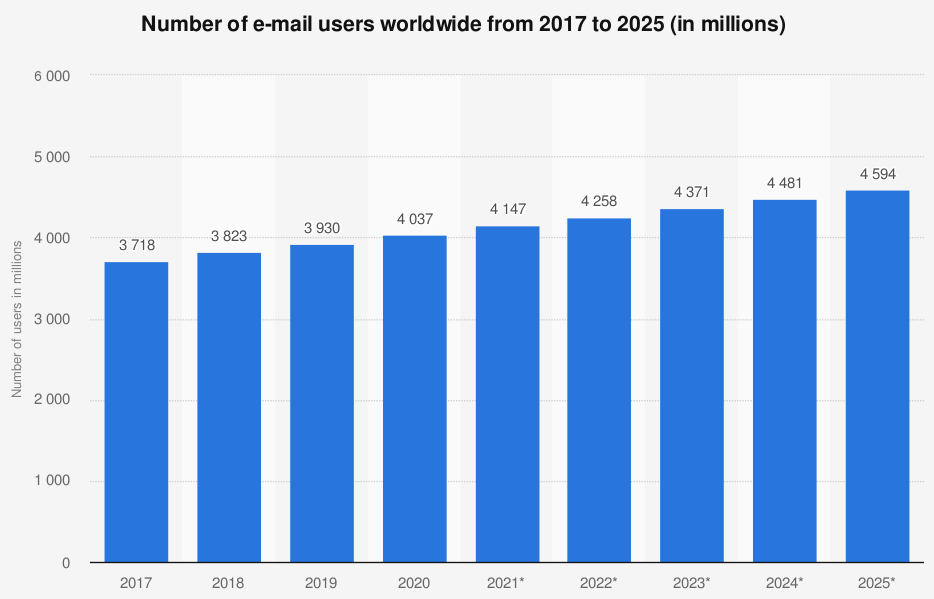
Source: Statista

Emails are still one of the most utilised forms of communication between people to date. According to Statista, there were roughly 4.1 billion email users in 2021. This number is predicted to rise significantly in the next few years.

The following characteristics highlight why emails should play a vital role in inbound marketing campaigns everywhere:

  • Emails allow brands and companies to convey their message as compellingly as possible.
  • You can personalize your words and the design of the email template to engage your customers.
  • Since email marketing is based on a person’s choice to opt-in, you have a clear number of people in your database that’s willing to receive your content and offers.
  • You may segment your audience based on their needs and wants to deliver optimised content and offers to the right audience at the right time.

How Can Email Marketing Fuel Your Overall Inbound Strategy?

There are 4 steps your inbound marketing strategy should take to convert leads into long-term, paying customers via email marketing.

1. Attraction

First, you’ll need a list of email addresses. Catch your visitors’ attention with popup forms, banners, PPC ads, social media advertising, and good-looking landing pages with useful content. At the ‘attraction’ stage, you want to give your site visitors an enticing reason to share their email addresses with you.

It may take some testing and tweaking, but you’ll eventually build an email list of interested people. It’s highly recommended that you also segment the email addresses you receive into the right categories to make management easier later on.

Related topic: How to Easily Collect Email Addresses for Free

2. Nurturing

As your email list grows over time, you should build up trust with your subscribers by ‘nurturing’ them. In the ‘nurturing’ stage, it’s all about retaining your leads and convincing them to turn into customers. Following up after they subscribed, send relational emails focused on building a good relationship with the customer to increase their trust in the brand.

Offer relevant advice or insight to your subscribers to reinforce your authority as a business that’s worth buying from. The free content can take the form of a blog post, short video, or downloadable ebook. Customers that trust your business are more likely to buy your product, so relational emails are an important part of the email flow.

Related topic: 7 “Thank You for Contacting Us” Page Best Practices

3. Conversion

If your nurturing strategies worked, your prospects should now be ready to proceed to the ‘conversion’ stage. This is the critical stage when you should run email drip campaigns with winning calls-to-action (CTAs).

Send promotional emails to increase awareness about your products, what services you offer, and any other deals your business might be running. In particular, coupons, discounts, free trials, and/or demos are a great way to convince your customer to make a buying decision!

Also, don’t forget to run A/B tests for each campaign before reaching out to your subscribers!

4. Advocating

After your prospect has clicked on your offer and purchased, it’s not over yet! Send transactional emails as a response to a customer’s actions to help keep them updated on the proceedings of their order. Order confirmations, shipping information, and receipts are all examples of transactional emails.

In the ‘advocating’ stage, you should still keep your customer’s attention because having repeat customers is great for business. Convince them to buy your product or services again by following up with more offers, related products they might like to buy, or even asking for feedback on your service.

Emails Complement Inbound Marketing Strategies

Email Marketing Providers

You should take advantage of various types of emails to meet your engagement goals. Email marketing can help improve the effectiveness of your inbound marketing strategy.

  • As a direct channel to your target audience, emails allow for open communication between the customer and your company.
  • As a medium that delivers more personalized content to customers, email marketing can sync up with your CRM and contribute rich data to external platforms.

If you’re looking for more great email marketing tips for driving results, read this article. If you’re looking for the right solution for your email marketing campaigns, try using a marketing automation platform like elfoMAP. Email marketing can be made easier with the right suite of design and support functions.

When a brand launches a product or a service, marketers have to create content that helps complement what it is the brand offers. This is where content pillars are helpful for marketers to stay focused on meeting the expectations and interests of their buyer personas.

Whether it is to explain an idea, solve a problem or help your target audience overcome a challenge they’re facing, you must be very clear what your content pillars should be, especially for social media.

Here’s a helpful guide with tips on how craft the right content pillars for social media.

What Are Content Pillars?

Content pillars can be defined as themes or a subset of topics for discussion related to a brand’s product or service. Segments of your target audience may be interested in different elements of a topic and content pillars are used to represent all of these.

Content creation for each pillar depends on the type of content and the right platform to share it on. Having your content pillars planned out early will make it much easier to formulate your content strategy and when to retarget previously-created content or images for social media.

How to Plan Your Social Media Content Pillars

marketing strategy

The content you create should always address the needs of your target audience and support the values of your brand. The more relevant your content is to your target audience, the higher chance it will resonate with them and build up your brand’s social media following.

1. Identify the Core Themes of Your Topic

When creating content pillars, the most important thing is to have at least 3-5 core themes to work with and be able to regularly produce content on.

For example, if your main topic is about women’s beauty, your subset of smaller topics could be on Makeup Tips, Fitness, Dieting, etc.

2. Decide on the Tone of Your Content

There should always be an underlying tone to every piece of content you produce. If it’s ideal, you can try to further categorise your content pillars. Here are some categories you can use for your social media content pillars:

Inspirational

  • Inspires your audience and lifts up their mood, encouraging them to engage with your content.
  • Presents your brand values in a highly relatable way to make connections with the community.

Promotional

  • Explains the benefits of your product/service briefly.
  • Presents your offer in a short, concise way that’s easily understood.
  • Uses strong CTAs for quick response.

Educational

  • Shares your knowledge and expertise on a particular topic of interest.
  • Simplifies a process or activity through “life hacks”.
  • Provide sequential tutorials or lessons to give people a reason to follow you.

Related topic: How Brand Loyalty Influences Consumer Behaviour

3. Use the Most Appropriate Content Format

To make your work as a content marketer much easier to manage in the long term, iterate your workflow and keep the material in your content pillars consistently engaging. Use the type of content that’s suitable for your purposes.

Bedrock/Long-Form Content

Blog posts, podcast episodes, and videos are long-form content that introduces many relevant concepts about your topic. Also known as bedrock content, this supports your overall social media marketing strategy by sharing more substantial information with your target audience.

Short-Form Content

Short-form content is built from long-form content. This is content you create to maximise long-form content by intentionally repurposing it as often as possible. This is mainly done via social media posts such as infographics, quotes, carousel posts, or 30-60 second videos.

Curated Content

Curated content can be repurposed content from your newsletter that helps you nurture your audience on social media and establishes your brand’s account as a trusted source for information.

Promotional Content

When it’s appropriate, incorporate offers that’s related to your products and services between your other posts. If it’s within the content itself, be sure to weave in your offers in a relevant manner.

4. Follow A Content Calendar

content calendar

The next step is to create a social media content calendar and record the day, time, platform, hashtags, and any relevant notes for each post before going out. This minimises the chance for any last-minute slip-ups in your posting schedule.

Ideally, your content should be planned out at least 2 weeks in advance. Don’t forget to record any significant dates within your content calendar, such as product launches or promotions

5. Review and Adjust Your Social Media Content Pillars

Once you’ve settled on the content format and decided the timings to post, it’s important to review your content pillars occasionally to ensure they’re still strategic and relevant to your target audience’s tastes.

The best way to do this is by using the following methods to adjust and refine your content strategy:

Look at user-generated content

Checking out what your followers post about your brand will inform you about how they engage with it, what they love about it, and what they don’t like so much. These accumulated opinions affect your brand image so modify your content pillars to solve problems, entertain, and inform your audience accordingly.

Related topic: Why is Content Moderation Important for User-Generated Campaigns?

Look at your data analytics

From the technical perspective, your brand’s social metrics will show you which content performs best in terms of format, style, and aesthetic choices. Evaluate this data and determine the next steps to take for your content creation.

Look at relevant hashtags

To ensure that your content continues to resonate with your target audience, take note of captions and hashtags that are receiving attention as references for future content creation. Look at how other brands are using them. Examine related terms and include more niche hashtags for a more granular level of understanding.

Conclusion: Take Care of Your Social Media Content Pillars

When crafted well, content pillars can help keep your social media strategy organized, consistent and on-brand. Listening to the feedback from your target audience will ensure that your content is always created for their value in mind.

Don’t know where to start to create the right content pillars for your brand? Then get in touch with our experts at elfo. We’re here to help elevate your marketing strategy and grow your business!

Too many companies measure and evaluate customer experience in aggregate, by segment. This method often neglects to take into consideration a customer’s unique experience and falls short of being an effective measurement system. Without knowing how to evaluate customer experience properly, companies are left feeling unsatisfied with their own customer-centric strategy.

In this post, we’ll explore a journey-based approach to measure customer satisfaction and various CX metrics you can use. We already touched on some metrics in a previous article about the importance of customer experience, but we’ll elaborate on more of them here.

Improving Customer Experience Measurement In 4 Steps

Digital Marketing Consulting Services

Deciding what customer experience metric to match with a touchpoint can sometimes be difficult. To deliver the right kind of impact and create more value, we recommend that you follow this four-step framework for measuring and evaluating customer experience:

Create a comprehensive customer journey map

Often overlooked, it is critical to have a detailed visual representation of the process a customer takes to achieve a goal with your website, product, or service. This customer journey map should identify customer motivations, needs, and pain points.

If you have all the touchpoints on the customer journey mapped, you can start figuring out the right analytics to properly assess your customer’s experience.

For an effective customer-centric strategy, having a comprehensive and transparent overview from the very beginning is recommended, as opposed to only looking at transactional touchpoints.

Determine what are your customer experience measurement priorities

Do not waste resources on approaches that return little to no value to your business or customers. Establish your customer experience measurement priorities ahead of time to avoid confusion and deviation from the plan.

For example, the most valuable journeys you may want to measure are those that can track the progression of customer and business goals.

By identifying what can drive or block journey success, you can ascertain the improvements needed for potential business impact. This makes it easier to define the right CX metrics and KPIs to measure customer experience.

Ensure the right point in the customer journey uses the right customer experience metric

There is a tendency amongst a lot of companies to use only one customer experience metric – typically NPS, CSAT, or CES – throughout the entire customer journey.

This single-metric approach is not effective. At each stage of the journey, the customer has different experiences and different needs, so how can you expect just one metric to properly assess each of these different stages?

Once you’ve understood different touchpoints with your customer journey map, you can identify more appropriate metrics to use for each touchpoint on end-to-end customer journeys. This is key to gathering actionable results in the long term.

For further optimisation, you can even try to discover micro journeys from within the important macro journeys.

Monitor customer experience metrics in real-time and over time

For company executives to get better insights into measurement efforts, CX teams need to share detailed reports on what customer experience metrics are working both at a journey level and at an overall level.

You can use analytics tools with built-in, custom dashboards to reveal real-time statistics and track these metrics over time. This in-depth reporting can also help you discover any high-impact micro-journeys.

6 Customer Experience Metrics Explained

If you’re just starting or have a customer experience measurement program already in place, it’s critical to understand the wide variety of ways to measure customer experience. Here are six key customer experience metrics that are popularly employed by CX experts.

Net Promoter Score (NPS)

Net Promoter Score (NPS) is one of the most widely used metrics because it’s easy to understand and simple to record.

NPS shows the percentage of your customers who would recommend you to others – i.e., friends, family, or colleagues – which helps measure word-of-mouth marketing.

On a scale of 0-10, customers rate your company, product, or service. They rate according to a preceding or following question that reads: “How likely are you to recommend […] to a friend or colleague?” The respondents are grouped into 3 categories:

SEO Digital Marketing Agency

From your surveyed customers, NPS is calculated by having the percentage of detractors subtracted from the percentage of promoters. If observed every month, the increase or decrease in NPS can help companies predict future revenue gain or loss and plan strategies accordingly.

Customer Satisfaction (CSAT)

Customer Satisfaction (CSAT) is the mean or average score of customers who rate from 1 to 5 for their satisfaction after a given experience. Measured by an automated survey, CSAT is most often used in customer service or customer support interactions.

Best Digital Marketing Platforms

Since it’s based on users’ reactions to a product or service experience, CSAT is a useful metric to record for many things such as a product return, a customer care call, or a password change. A lot of businesses send out surveys to obtain a CSAT score within 30 minutes of a product or service being used.

Customer Effort Score (CES)

Customer Effort Score (CES) records the relative effort that customers put into figuring out a solution to a problem they’re facing with a product or service.

This problem could be a simple one such as looking for a product or a more difficult one such as resolving a technical issue.

Defined by a 5- or 7- point scale system, CES is usually measured by an automated survey. A typical CES question is to ask “How much effort did you have to put in to resolve this issue?” and the responses could vary from ‘Very difficult’ to ‘Very easy”. Follow both the mean or average score and the distribution of scores for the results.

CES is a good metric to measure because customers are looking for fast and convenient resolutions to problems and their survey responses can help determine whether your efforts to reduce these obstacles are effective or not.

Customer Churn Rate

Customer churn rate is a measure of how many customers stopped using your products or cancelled their subscription service in a given period of time. Keeping track of customer churn rate is critical for subscription-based business models because generally, it is much less expensive to retain existing customers than it is to acquire new ones.

Affordable Digital Marketing Services

Average Resolution Time

Average resolution time is the measure of the time it takes to completely resolve an issue from beginning to end. Also referred to as ‘Time to Resolution’, ‘Mean Time to Resolution’ and ‘Resolution Time’, this metric correlates well to CSAT and CES.

Messaging Platform

It’s quite simple to understand the results: the longer it takes to resolve customer complaints and issues, the more unsatisfied they are. This metric is useful in presenting how well your team is performing and how efficient your processes are.

First Contact Resolution (FCR)

First Contact Resolution (FCR) measures the number of customers whose question or request is resolved on the first attempt. This metric is usually recorded alongside Average Resolution Time for more thorough observation of CX efforts.

Digital Programmatic Advertising

When you get the results, take note that a high FCR typically indicates high customer satisfaction. This also can translate into your customer service processes and teams working efficiently and producing desired results.

Creating the Right CX Measurement System is A Work in Progress

Best Email Marketing Platform

For companies to get the best value out of their customer-centric strategies, building an effective customer experience measurement program is essential to understand which parts of your customer experience are working and which parts need to be improved.

Applying the right CX metrics at the right stage of the journey to get the best results, however, takes some time and practice.

Talk to our experts today to find out how to optimize your customer experience and utilise a suitable journey-based approach for all your marketing needs.

We provide various services ranging from SMS marketing and email marketing to social media advertising as part of our digital marketing services.

Able to be customized from top-to-bottom, email is a valuable marketing medium that permits companies to reach out and connect to an audience in ways that cannot be beaten. However, it’s not enough to just craft top-quality emails. To cultivate the kind of relationships you want to leverage from your email marketing efforts, you need to collect email addresses to build a healthy list of subscribers. Here are some very useful tips to grow subscribers effectively.

IMPORTANT: Never buy a list

First, you may ask “Isn’t it simpler to just buy a list of emails?” The thought of building an email subscriber base from scratch can seem intimidating, but the worst thing you can do is buy a list. Not only is it an illegal practice to sell email lists, but you also shouldn’t rely on email addresses that did not subscribe to you in the first place! It hurts your email marketing legitimacy because people will most likely mark your messages as spam.

Collect Email Addresses Through Sales/Established Connections

Always think about “What’s in it for the customer?”

Consider what value do you bring to your customer when they sign up for your newsletter. Always make sure to tell them how your offer — whether it’s a newsletter, online course, case study, or membership — will DIRECTLY benefit them. Nothing is more irresistible to a potential customer than a free product (also called a lead magnet) or trial of a service that serves a useful purpose.

Be human to get your points across clearer

Avoid giving a sales pitch like a robot. Write in a way that will help your customers relate to you better. Email templates can do the job fine if they’re done properly, but be sure to tailor them to your individual prospect or target audience. Depending on what situation they are in, people communicate very differently, especially at certain points in the conversation.

Leverage your email signature/closing

When creating emails, most businesspeople today use a shortcut in their app to put down their email signature. Why not also include a link to a form or landing page here? Your email content may not necessarily be related to the link nor might it lead to a ton of new email signups, but it’s a simple, passive way to spread awareness of your offer.

Make your emails easy to share and subscribe to

This is one of the most important optimizations that’s easy to miss. Update your email template to include social sharing buttons. By embedding the sharing function, you make it easier for your subscribers to forward your message to other potential customers.

Collect Email Addresses from Your Website

Ensure a form is present throughout for maximum coverage

Even if you have it on your top product and service pages, it’s best to have a sign-up form on just about every page so that anyone who lands on your site can sign up quickly for your emails. Don’t fall into the common trap of thinking people only land on the homepage or your “top-performing pages.”

Most website visitors come from Google, Facebook, or a link shared on a blog, which means traffic does not necessarily end up directly on your landing page. They could be redirected to a specific page on your site that relates more closely to what they were looking for instead.

Don’t neglect form placement

Yes, you may have already put a sign-up form on every page on your site, but test its location using various page templates. This a small detail but your form placement also counts towards its pickup. For example: if a page has the sign-up form at the bottom, it isn’t going to get as much visibility as it would have in the sidebar or above the fold. Put your inline web form in an easy-to-find, consistent spot.

Simplify what info you’re asking for in the form

It’s wise to review your current web form and consider that getting ALL your customers’ details upfront may actually hinder signup. The longer the form length, the lesser number of signups you will receive. Request only what you really need from prospects at this stage to get them onboard.

That doesn’t mean you should put aside collecting any information that helps you personalize your email content. As mentioned before, clearly communicate what your website visitors will receive after signing up. Give them a reason to subscribe.

Related topic: How to Write A Good Landing Page Copy That Sells 

Supplement purchases with further incentives

After a customer purchases something on your website, they should be redirected to a Thank You page. This page on most websites tend to be quite plain so why not take advantage by sticking a CTA here to relevant links. Build customer loyalty at every point of the journey. By leveraging the point of purchase to collect email addresses amongst other actions, you’re more likely to create repeat customers and increase your conversion rate.

Related topic: 7 Thank You Page Best Practices to Increase ROI

Give pop-up forms a try

Another simple yet effective way to bring attention to your email newsletters is with pop-up forms. However, be careful not to interrupt or annoy your website visitors with forms that pop up in the middle of a screen and darken the background content. The best options are to use a “sticky” form that unobtrusively remains on the bottom of the page as a user scrolls or a “timed” form that pops up after a user has been on the page for a certain amount of time.

Collect Email Addresses from Social Media and Other Channels

Promote to your social followers

It’s pretty obvious at this point but any capable business owner that wants to engage with online users should have a consistent social media presence. If you see most major brands across social media, they actively inform customers and the public about special offers to build their brand awareness.

You can also do the same thing by using channels, such as Facebook and Instagram, to grow your email marketing list too. If you already have people following your business on social media, why not encourage them to sign up for your email list too for more content? Tapping into an audience of people who are already interested in what you do is the fastest way to build a healthy list of subscribers.

Leverage more than one list of contacts

Do you have multiple lists of contacts interested in various things? Compare the similarities and consider cross-promoting your offers on one list to the other if they’re relevant. Not only could you cover more ground and hopefully get more conversions, but this way also ensures that you maintain consistency in your efforts of convincing people that there’s value to be obtained from subscribing to your email list.

Boost Your Email Marketing Strategy Today

Do you want to grow your subscriber base and build more personal relationships with customers? Empower your marketing strategy by using an email marketing automation platform like elfoMAP. Email marketing can be made easier with the right suite of design and support functions.

In the highly competitive digital marketing space, programmatic advertising affords marketers the opportunity to observe digital campaign performance closely with actionable measurements. Brands can acquire insights into what their target audience thinks about their ads and assess how much ad exposure is necessary to achieve their objective. To do this, marketers have to learn how to measure programmatic advertising effectively.

In order to determine success of their digital campaigns, brands have always used measurement to improve their media and creative strategies. Today, there are solid measurement tools that can bring new levels of speed and ability to act according to the shift in audience perception: programmatic advertising and integrated platforms. The real-time feedback loop enabled by such technology helps brands to optimize each digital interaction to be better than the last.

What is Programmatic Advertising and Why Use It?

Simply put, programmatic advertising – or programmatic ad buying as it’s also called – is the use of software to purchase display space on the Internet for digital advertising. With machines and algorithms, programmatic ads have allowed brands more time to better plan, better optimize, and better target their advertising.

For marketers, it is an efficient use of both time and resources. Designed to throw out the hit-or-miss campaign design that was costing brands a lot of money, programmatic advertising relies on an algorithm that determines where ad spend is most effective. All that’s required to get the system running is feeding it some information about your digital campaign and you’re all set. Going programmatic allows businesses to understand the media journey better than before and get in tune with what entices prospective buyers to click through.

If you’re not clear from the beginning what you’re trying to achieve with your digital campaigns, however, programmatic advertising can get tricky easily. Evaluating campaign success and performance can only be tracked and measured accurately when you set specific goals and measure these goals against specific Key Performance Indicators (KPIs).

The KPIs You Need to Measure Programmatic Advertising

programmatic advertising kpi

To decide what KPI to measure against, you must be clear early on what your business objectives are and how they tie into your campaign goals. Once you have this established, you can work backward and choose what campaign targeting tactic will work best to achieve your goal and KPI. Here are the KPIs that you should be keeping track of on your programmatic advertising platform:

  • Impressions

Impressions help you calculate brand awareness. They indicate reach, or more accurately, the total amount of times that your display ad was shown on a third-party site. To achieve brand awareness, you will likely measure your campaign’s success based on how many people you reach. However, be wary: the numbers displayed as impressions do not indicate that a person saw your ad, it just means that your ad was displayed. If you’re running an awareness campaign aimed at gaining impressions, you could try a contextual campaign for desktop or a hyperlocal campaign for mobile.

  • Clicks

Clicks help you understand how well your audience is responding to your marketing message. They point out the number of people interested enough in your ad that they click on it and visit the corresponding product/service landing page. The more users who have clicked on your ad, the more interest there is in the offer. If you’re running an engagement campaign aimed at getting clicks, you could try a video campaign or mobile app campaign to get users to click to learn more. Ultimately, clicks bring visitor traffic to your website, so this also helps boost your website’s ranking on Google.

  • Conversions

When the user completes a specific action on a landing page, this counts as a conversion. You can calculate conversions based on a campaign goal that you’ve specified, such as free trial signups or actual product sales. If you’re looking for sales, conversions, or customer acquisitions, perhaps try focusing on retargeting campaigns as this tactic will bring users who are familiar with the brand back to the website.

  • CTR (click-through rate)

CTR is the percentage of people who see your programmatic ad and click through to the post-click landing page. A low CTR compared to a high impression count signifies that users are seeing your ad but aren’t clicking through. If your CTR is below average, it’s highly recommended to A/B test your ads to see what your audience responds to best.

  • CR (conversion rate)

CR is the percentage of visitors to your website that becomes a “convert” by completing a desired goal. A high CR is indicative of successful marketing and landing page design, meaning people want what you’re offering! The best way to raise your CR is to ensure your landing page is optimized and the offer is solid. If what you’re offering is truly worthwhile, people who visit your site will want to get it.

Related topic: 7 Thank You Page Best Practices to Increase ROI

Track KPIs According to the Intended Campaign Goal

tracking kpis

While all the KPIs listed above are indeed important to measure programmatic advertising and brand relevancy, not all of them will necessarily be taken into equal consideration. It depends on the type of campaign your brand plans to run. Without continuously monitoring your KPIs, you cannot accurately determine what ads to pause or modify, divert more spending, etc. The quantifiable data gathered from these KPIs for programmatic advertising empowers you to understand whether your advertising ROI is on par with others in your industry.

Contact our experts at elfo for consultation on all your programmatic advertising needs.

In today’s competitive digital landscape, it’s not enough to just drive tons of traffic to your e-commerce website; you have to know how to write a good landing page copy that sells. The ability to quickly convert visitors into paying customers is what every business online aspires for. But which attributes describe a good landing page experience?

Your website may offer the best product or service found on the Internet, but if your landing page content is off even slightly, visitors will take notice of this and leave. It’s already bad enough that the average person’s attention span is 8 seconds! You don’t want to drive away potential customers to the competition and hurt your brand.

Keeping a person’s attention in a growing online consumer-driven world is a tough job for anybody in acquisition marketing. To get an attractive ROI and enable your sales team to see more conversions, it is advised that whoever writes copy for your website always prioritizes optimizations for an effective landing page.

Key Tips to Consider When Writing Landing Page

In essence, landing pages should be giving Internet users a place to ‘land’ – offering valuable information and relevant insight for people to engage with and convert in ways they had not previously thought of. These are not all hard-and-fast rules, but here are some helpful tips to create appealing landing page content that can enable the desired conversions for your website.

Be Concise with Your Headline and Subheading

When visitors first land on your page, the headline should be the first thing that captures their attention. Depending on what your headline says, it can influence whether your readers stay and engage or navigate away to something more enticing. That’s why it’s critical that you have a clear and concise title.

In a good headline, the wording of your offer should be easy to understand for all viewers. Be transparent and tell visitors what kind of product or service they’re signing up for. The more RELEVANT information you can provide in the headline, the quicker your prospects can get on board and convert.

Ultimately, the main idea of a headline is to get to the point FAST. Here are some examples:

  • “Sign up for your free account”
  • [solution] just got easier. And it’s getting results.”
  • “Get Started with [product name]

Do not cram all of your information into the headline. Reserve the rest of the value proposition for the subheading under your main headline. This allows you to provide more vital information about the benefits of your offer.

Here are a few examples of headlines with actionable subheaders:

  • [solution] That Work: Why are you still wasting time on [action]?”
  • “The 10 Steps to [action]: Get Ready to Ensure Your [desired outcome]
  • “Launch an Online Business: Ready to take charge of your career by starting a business of your own?”

Focus on Your Target Audience

Do not deviate content from who you’re addressing it to or else you may end up confusing your product or service’s purpose. Ensure what you put into your copy is in line with your target audience’s demographics and characteristics. Research what their habits are, what they want and need, and how they speak.

By being aware of all these important factors from the outset, your copy will stand a better chance of being much more focused, clear, and direct. Plus, when you have one target audience in mind, rather than a largely undefined group, you can gather more accurate insights, such as how well your landing page is performing for a specific campaign.

For example, it’s useful to have a tracking tool that can add scripts onto your landing pages to send and receive data from Google Analytics, Google Ads, Facebook Ads, etc.

Related topic: 7 Thank You Page Best Practices to Increase ROI

Address Your Reader in the Second Person

How do you get someone to pay attention to you in real life? You speak to them directly! It’s the same when you want to write a compelling landing page copy.

To engage your audience straight away, you want to break away from the traditional writing habit of writing in the first or third person. You should be using the second person instead, which means writing in the language to speak directly to the reader. This type of writing usually includes:

  • Words and phrases such as “you,” “your,” and “yours.”
  • Direct sentences or call-to-action that tell the reader to do something, such as “Sign up here,” “Take the first step,” “Try this now,” etc.

Include Stats and Facts to Support Your Value Proposition

To differentiate product offerings in a sea of other related items online, some companies would use hard data to drive a harder bargain for their prospects. If you have access to such information, try and include RELEVANT facts, figures, and statistics in your landing pages.

When you can demonstrate the value of your product or service more effectively, these details will help compel your readers to take action with more confidence.

Format Your Landing Page Copy in Easy-to-Skim Bites

While you should ensure your headline and subheader gives a good idea of the value of your offer, those alone may not be enough to convince some readers to fill in their contact information on a form at the end of the page. Consider including a few short sentences or bullet points that clearly state what else the offer includes.

In a brief and clear list, you could outline and answer any questions visitors might have about the offer. What does the visitor stand to gain from the offer? How does your offer teach them various ways to use your product? Are there cost savings? Be sure to break up large blocks of text and use bullet points to draw eyes to key takeaways.

Sometimes, a good landing page copy is dependent on the way words are displayed on the page. Just as important as the phrasing, your copy needs to be formatted in a way that makes it easy for readers to scan and find the information they need in a few seconds. Great landing page copy is usually formatted using a combination of:

  • Headings and subheadings
  • Bulleted lists
  • Short paragraphs and sentences
  • Font formatting such as bolding and underlining
  • Standalone quotes from your clients or company representatives (optional)

Use the Words/Language Your Target Audience Is Familiar With

Where it’s appropriate, write in the style that enables you to connect more closely with your readers. Speak to them in the language that they know. Try as much as possible to avoid jargon, industry slang, or any other type of terminology your target audience may not understand or use.

Display Customer Testimonials for Social Proof

Adding customer testimonials in your copy helps your product offering look more accessible and valid. As a form of social proof, they can simplify your readers’ purchasing decision by making it easier for them to imagine how your products will make their job/task/life easier.

Think about it: if you were a customer, wouldn’t you want to know that a service had been satisfactory for other people before you choose to buy or sign up? Real and credible testimonials prove that a service has worked for these people and that it can work for you too. As such, they have the potential to dramatically increase the effectiveness and persuasiveness of your landing pages across the Internet.

The Not-So-Secret Trick of Good Landing Pages

Most businesses would like to think that coming up with landing page content is simple. After all, you can insert pictures and videos to convey product or service information, and any landing page would seem attractive and capable enough to pull prospects in easily. This is a common strategy to deploy in the current media-rich landscape, but it does not guarantee a winning formula.

Truthfully, the real (and lasting) trick to curating great landing page content is to always maintain a single, clear message to sell something of ‘specific value’ to someone who ‘needs’ it. Whether it’s one offer, one promise, or one big idea, your content should have action-oriented copy that capitalizes on your readers’ sensibilities, encouraging them to take the action or next step you want.

Now that you know which attributes describe a good landing page experience, you’re probably wondering what else could you do to improve your website. If you want to create unique-looking landing pages to advertise your products or services, why not sign up for elfoAIM? Save time and effort on building landing pages from scratch with a drag-and-drop toolkit and a library of attractive landing page templates to choose from.